Electric car vs petrol in 2026: the 7 decisive factors with real data
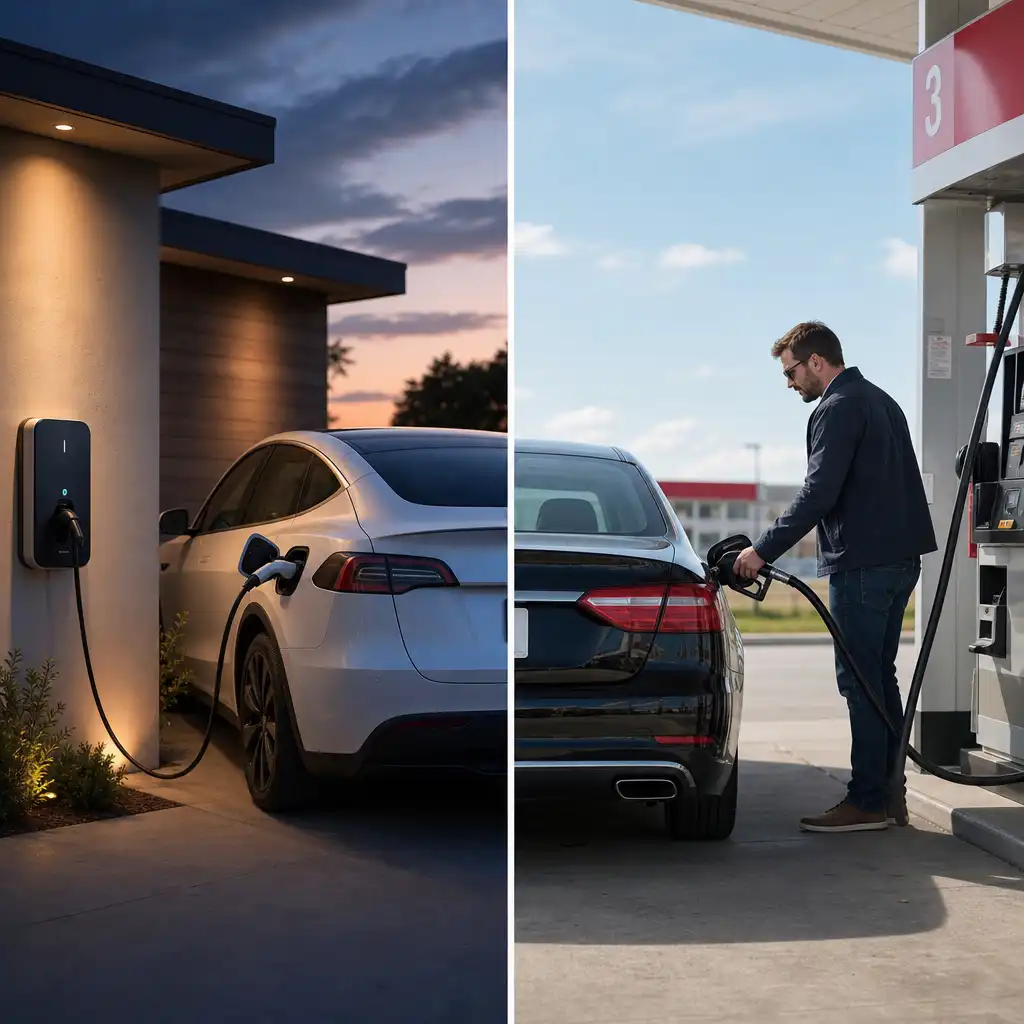
Choosing between an electric car and a petrol car in 2026 is not just a matter of preference — it is a financial, logistical and environmental decision that will shape your life for the next 10 years. Data shows that 43% of car buyers in Europe still cannot decide, precisely because the differences between EVs and petrol cars go far beyond fuel type. This article breaks down the seven decisive factors with real numbers, no spin, and none of the usual clichés.
Table of Contents
- Quick Summary
- 1. Purchase Price
- 2. Daily Running Costs
- 3. Range and Charging
- 4. Maintenance
- 5. Environmental Impact
- 6. Driving Experience
- 7. Residual Value and Resale
- EV vs ICE Comparison Table
- Frequently Asked Questions
Quick Summary
| Key Finding | Explanation |
|---|---|
| Total cost of ownership favours the EV | For most usage profiles, an electric car is cheaper over 5 years, even accounting for a higher purchase price. |
| Home charging changes the equation | If you can charge at home overnight, the cost per kilometre of an EV is 3 to 5 times lower than petrol. |
| ICE still wins on long-distance range | For frequent trips over 500 km without planning, petrol vehicles remain more convenient in 2026. |
| EV maintenance is objectively cheaper | No oil changes, clutch or timing belt — average annual savings of €600–800. |
| EV carbon footprint improves over time | Battery manufacturing emits more CO₂, but this is offset between 15,000 and 30,000 km of use. |
| EV residual value is uncertain but improving | Post-2022 EVs from established brands show depreciation rates comparable to equivalent ICE models. |
| Comparing specific models is essential | The gap between a €30,000 EV and a €65,000 EV is as wide as the gap between EV and ICE. Use a direct comparison tool to avoid costly mistakes. |
1. Purchase Price: The Sticker Price is Not the Whole Story
The most common mistake when comparing an EV with an ICE car is focusing only on the list price. In 2025, the average price of a new electric passenger car in the EU was around €38,000, compared to €28,000 for a petrol equivalent, according to ACEA data. That €10,000 gap looks daunting, but it ignores three factors that fundamentally change the calculation.
The first is government incentives. Most EU countries and the UK offer purchase grants or tax benefits for EVs — ranging from France's bonus écologique of up to €7,000 to the Netherlands' private lease subsidy schemes. The second is taxation: many municipalities offer vehicle tax exemptions or reductions for EVs, plus free or discounted access to low-emission zones. The third, and most overlooked, is the total cost of ownership (TCO) over 5 years, which includes fuel, maintenance, insurance and taxes.
How to calculate the real cost before signing
The smartest move is to calculate the 5-year TCO before making any decision. A buyer covering 15,000 km per year who can charge at home can recover the price difference in under 4 years, according to McKinsey's analysis of EV adoption in Europe. Tools like Wise EV let you compare EV models built after 2019 directly against their ICE equivalents, using real ownership cost metrics rather than just spec sheets.
Tip: Before ruling out an EV on purchase price, calculate the 5-year TCO including local incentives, fuel savings and reduced maintenance. For most urban or mixed-use profiles, the initial gap disappears before year three.
2. Daily Running Costs: Electricity vs Petrol
This is where the EV wins most clearly and consistently. With an average overnight home electricity tariff of around €0.12–0.18/kWh across the EU and real-world consumption of 18 kWh/100 km for a compact electric car, the cost per kilometre is approximately €0.02–0.03. An equivalent petrol car with 6.5 l/100 km consumption at €1.65–1.80/litre costs €0.10–0.12 per kilometre. The data is consistent: home charging overnight is 4 to 5 times cheaper than filling up with petrol.
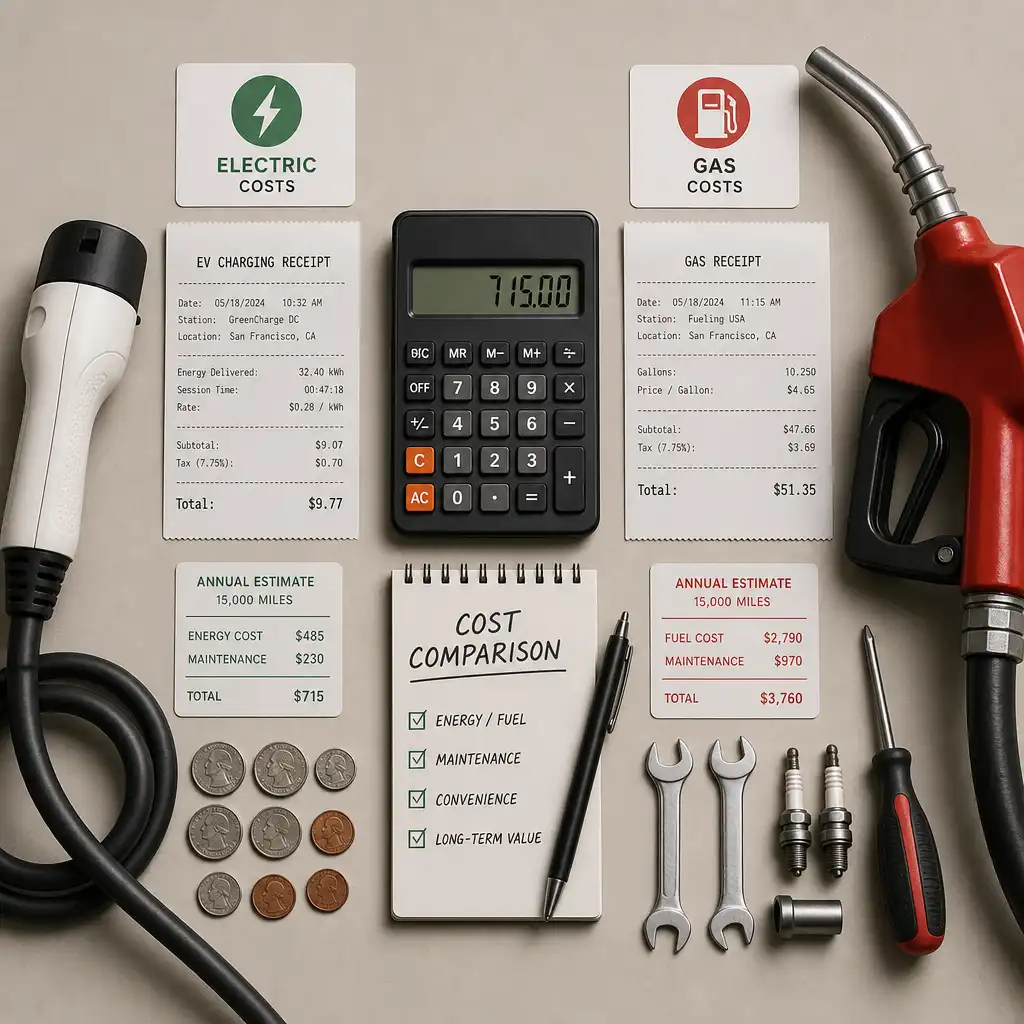
The picture changes if you rely exclusively on public fast chargers. DC chargers of 50 kW or more typically cost €0.40–0.55/kWh across the EU, pushing the cost per kilometre up to €0.07–0.10. Still competitive against petrol, but the gap narrows significantly.
Your usage profile determines the real saving
A city driver with a home charging point and daily trips under 80 km will get maximum financial benefit from an EV. A self-employed driver covering 600 km a day on secondary roads without guaranteed access to fast charging will see that benefit shrink. The question is not whether an EV is cheaper in the abstract — it is whether it is cheaper for your specific profile.
"Electrification of transport does not have a single business case. It has as many business cases as there are driver profiles." — Energy Transition Report, McKinsey Center for Future Mobility, 2024.
3. Range and Charging: The Big Question
The average real-world range of a mid-range electric passenger car sold in 2025 exceeds 400 km on the WLTP cycle. In real winter conditions, on a motorway at 130 km/h, or with air conditioning on full, that figure can drop by 20–35%. The equivalent ICE car does not have that problem: its range is practically constant in any conditions.
For the vast majority of European drivers, whose average daily commute is below 50 km according to European Environment Agency data, the real-world range of any modern EV is more than sufficient. The issue is not range itself — it is range anxiety, a documented psychological phenomenon that disproportionately affects prospective EV buyers with no real experience of driving one.
Charging times by technology
| Charging type | Power | Time for a 60 kWh battery |
|---|---|---|
| Domestic socket (3-pin) | 2.3 kW | 26 hours |
| Home wallbox | 7.4 kW | 8–9 hours |
| Public AC charger | 22 kW | 3 hours |
| DC fast charger | 50 kW | ~75 min (0–80%) |
| DC ultra-rapid charger | 150 kW+ | ~25 min (20–80%) |
| ICE petrol refuel | — | 3–5 minutes |
A full home wallbox charge (7.4 kW) takes 8–9 hours — overnight while you sleep. A 150 kW DC fast charger can take the same battery from 20% to 80% in around 25–30 minutes. Petrol takes 3 minutes: that advantage is real and matters for frequent long-distance drivers.
Tip: If you make more than 4 trips per year of over 400 km in a single day, factor in the added en-route charging time as part of your real cost. For most buyers, that added annual time is under 5 hours. For daily long-distance drivers, it can be a decisive factor.
4. Maintenance: Who Wins Long-Term
This is one of the areas where the EV advantage is most objective and least debatable. An electric motor has 15–20 moving parts. A combustion engine has over 2,000. That difference in mechanical complexity translates directly into fewer breakdowns, fewer service visits and lower costs.
A typical ICE vehicle requires oil changes every 15,000–20,000 km, air, fuel and cabin filters, timing belt inspection every 60,000–120,000 km, exhaust system maintenance, a clutch on manual versions, and more frequent brake servicing. An EV eliminates virtually all of those items. Brakes last longer because regenerative braking reduces wear on pads and discs.
How much do you actually save on maintenance?
According to a Consumer Reports analysis published in 2023, EV owners spend on average 40% less on maintenance than owners of equivalent ICE vehicles. In concrete terms for European buyers, that represents €500–900 per year, depending on model and usage. The area requiring close attention in an EV is the battery: even though manufacturers typically offer 8-year or 160,000 km warranties, gradual capacity degradation is a real factor worth monitoring.
5. Real Environmental Impact
The debate around EV environmental impact tends to get stuck between two equally imprecise positions: those who claim EVs pollute more because of battery manufacturing, and those who claim they are zero-emission. Neither is accurate.
Manufacturing the battery for a 75 kWh EV emits between 8 and 12 tonnes of CO₂ equivalent, depending on the origin of lithium and cobalt. An equivalent ICE vehicle emits less during manufacturing, but more than compensates for that over its lifetime. According to European Environment Agency (EEA) data, an electric passenger car emits 60–70% less CO₂ over its full lifecycle than a petrol equivalent on the average 2024 European electricity grid.
The footprint depends on where you charge
If charged on renewable electricity, the EV's environmental advantage is overwhelming. If charged on coal-fired electricity, the advantage shrinks significantly but does not disappear entirely over the full lifecycle. Across the EU, where renewable energy's share of electricity generation reached around 45–60% in 2024 depending on the country, the EV carries a clear and growing environmental advantage.
6. Driving Experience
The difference in driving between an EV and an ICE is greater than most people expect before they try one. The electric motor's instant torque delivers full power from 0 rpm: a 204 hp EV accelerates from 0–100 km/h faster than a 204 hp ICE car for precisely this reason.
The absence of gear changes in most EVs simplifies city driving and stop-and-go traffic. Cabin silence is another factor that many drivers come to value after the first week of ownership. Some drivers accustomed to combustion engines do miss the progressive throttle response and the acoustic experience of revving hard.
City driving vs motorway
In the city, the EV is objectively more comfortable, more agile and cheaper to run. On long motorway journeys at sustained 120–130 km/h, EV consumption rises more sharply than an ICE car's, and planning charging stops adds a layer of management that does not exist with petrol. The city experience clearly favours the EV. Long motorway journeys are still simpler in an ICE in 2026, though the rapid-charging network is improving fast.
7. Residual Value and Resale
Until 2022, accelerated depreciation was one of the strongest arguments against EVs. First-generation models lost 30–40% of their value within two years, partly due to uncertainty about battery durability and partly because new model specifications were improving quickly.
The situation has changed noticeably for post-2021 models from established brands. A 2022 Tesla Model 3 retains 65–70% of its value after two years, comparable to an equivalent BMW 3 Series according to data from European used-car platforms. Models from less-established brands or with smaller batteries continue to depreciate faster.
What factors most affect EV residual value?
Brand reputation, battery capacity, DC fast-charging capability and software update history are the four factors that most influence EV residual value in the second-hand market. A buyer who chooses a model with at least 60 kWh battery capacity, 100 kW+ DC charging and a brand with an established service network will minimise the risk of accelerated depreciation. To compare these parameters across specific models built after 2019, Wise EV offers direct comparison without having to cross-reference spec sheets from different sources.
EV vs ICE Comparison Table
The table below compares the most relevant metrics for deciding between an electric and a petrol car in the EU/UK market in 2026.
| Factor | Electric Car (EV) | Petrol Car (ICE) |
|---|---|---|
| Average purchase price (mid-range, 2025) | €35,000–45,000 (before incentives) | €25,000–35,000 |
| Cost per km (home overnight charging) | €0.02–0.03/km | €0.09–0.11/km |
| Average annual maintenance cost | €300–600 | €900–1,400 |
| Real-world range (mixed conditions) | 280–380 km | 500–700 km |
| Full refuel/recharge time | 30 min (DC fast to 80%) / 8–9 h (home) | 3–5 minutes |
| Lifecycle CO₂ emissions | 60–70% less than ICE (EU grid 2024) | Reference baseline |
| Depreciation at 2 years (established models) | 25–35% | 25–35% |
| Government incentives | Varies by country — up to €7,000–9,000 in some markets | Not applicable |
| Low-emission zone access | Unrestricted (zero-emission category) | Restricted in growing number of EU/UK cities |
Frequently Asked Questions
Is it worth buying an electric car in 2026 if I have no home charger?
It depends on public charging density in your area and your usage profile. If you live in a city with accessible public charging and your daily trips are under 100 km, an EV without home charging can still make financial sense. The cost per kilometre at a public charger is still lower than petrol in most tariffs. However, if you rely exclusively on DC fast chargers for daily use, the economic advantage shrinks and convenience decreases. The best way to assess your specific case is to compare models matching your actual usage at Wise EV.
How long does it take an EV to pay back its higher purchase price?
For a driver covering 15,000 km per year who charges mainly at home, the financial break-even point against an equivalent ICE is reached in 3–5 years, depending on the model and incentives applied. The most important variable is not purchase price but accumulated energy and maintenance costs.
Does EV battery degradation really happen quickly?
Not at the rate commonly claimed. Real-world fleet studies show that modern lithium-ion batteries lose 2–3% of capacity per year under normal use. An EV bought in 2025 with 400 km of range will still have over 300 km of real-world range after 10 years with reasonable use. The factors that accelerate degradation are frequent charging to 100% for extended periods and intensive use of ultra-rapid charging as a daily habit.
Are electric cars safer than petrol cars in an accident?
In terms of passive safety in collisions, modern EVs score equal to or higher than ICE equivalents in Euro NCAP tests. The battery, located in the vehicle floor, lowers the centre of gravity and improves stability. The specific EV risk is battery fire after severe impacts, which is statistically rarer than fires in ICE vehicles but requires different firefighting protocols.
Is it worth buying an ICE in 2026 given future restrictions?
It is a legitimate question and the honest answer depends on your time horizon and usage. The EU has mandated an end to new ICE car sales by 2035, but existing vehicles will continue to be usable beyond that date. Low-emission zone restrictions are already a reality in a growing number of European and UK cities. If your daily mobility includes entering restricted zones, an ICE without a zero-emission rating already carries a real cost in fines or detours today — not at some future point.
Have you already compared an EV with your current petrol car? Tell us which factor surprised you most and whether any of these differences changed your view on which type of vehicle to choose.
References
- McKinsey Center for Future Mobility — EV adoption and total cost of ownership in Europe
- European Environment Agency (EEA) — Lifecycle CO₂ emissions: EVs vs petrol cars
- ACEA — European Automobile Manufacturers' Association statistics
- Consumer Reports — EV vs ICE maintenance costs (2023)
- IEA — Global EV Outlook 2025
- Euro NCAP — Passive safety ratings for electric vehicles