Hyundai Ioniq 5 vs Kia EV6: Rival Siblings or Twins?
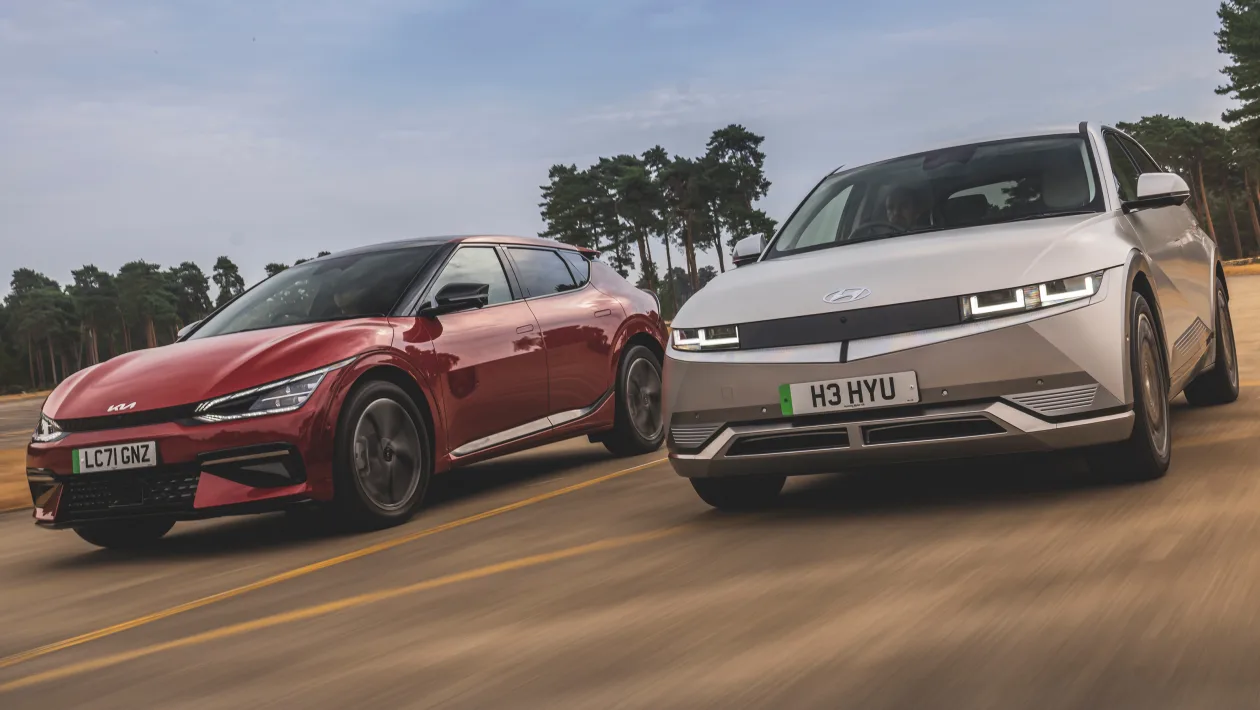
If you are looking for your first electric car or thinking about leaving combustion behind, there is a good chance the Hyundai Ioniq 5 vs Kia EV6 comparison is the one giving you the most doubt. And that makes sense: both models share the same E-GMP platform, sit at similar prices, and come from the same group, Hyundai Motor Group. But in practice they are cars with distinct personalities, built for different drivers. This analysis breaks down exactly how they differ and which one fits your buying profile best.
Table of contents
- Quick summary
- E-GMP platform: shared base, different results
- Design and interior space
- Performance and range
- Fast charging and efficiency
- Full comparison table
- Technology and equipment
- Price and real value
- FAQ
- References
Quick summary
| Key fact | Explanation |
|---|---|
| Same platform, different character | Both use E-GMP, but the Ioniq 5 prioritises comfort and space, while the EV6 aims for dynamism and a sportier drive. |
| Ultra-fast DC charging up to 233 kW | Both models peak at 233 kW on DC and can recover up to 100 km of range in roughly 5 minutes under ideal conditions, thanks to their 800V architecture. |
| Higher real range on the EV6 | The Kia EV6 Long Range RWD claims up to 528 km (WLTP), beating the equivalent Ioniq 5 at around 507 km. |
| The Ioniq 5 wins on cabin space | The Ioniq 5's wheelbase (3,000 mm) is longer, translating into more room for rear passengers. |
| The EV6 GT is faster | The EV6 GT hits 100 km/h in 3.5 seconds with 585 hp, versus 5.1 seconds for the standard dual-motor Ioniq 5. |
| Moderate price difference | Across most of Europe the EV6 tends to come in roughly €1,000–3,000 cheaper in equivalent trims, depending on the registration quarter. |
| Bidirectional V2L on both | Both models include Vehicle-to-Load (V2L), letting you power external devices directly from the battery. |
E-GMP platform: shared base, different results
The E-GMP platform (Electric-Global Modular Platform) was developed by Hyundai Motor Group as the structural base for all its new-generation EVs. Launched in 2021, it integrates the battery into the chassis floor, removing the central tunnel and freeing up cabin space. This design let Hyundai and Kia engineers build two cars with different philosophies on the same architecture.
What makes this comparison interesting is exactly that: you are not choosing between different technologies, but between two interpretations of the same technology. The 77.4 kWh battery is identical in both. The 800V electrical system is shared. Even several battery-management software modules are the same.
Where they diverge is in chassis tuning, suspension geometry, body design and product positioning. Kia took E-GMP and built a dynamic fastback. Hyundai took the same base and built something closer to a futuristic MPV.
Tip: With a comparison platform like Wise EV, you can filter both models by concrete technical specs — peak power, WLTP range, price per kWh — to decide based on real data rather than brand impressions.
"The E-GMP platform represents Hyundai Motor Group's biggest technological leap in two decades. It is the base on which we will build all our premium EVs." — Euisun Chung, Chairman of Hyundai Motor Group, at the official EV6 unveiling (2021).
Design and interior space
The Ioniq 5 has a styling that divides opinion. Its retro-futuristic design, with pixelated lines paying tribute to the 1970s Pony, is striking and recognisable. The EV6, by contrast, goes for more organic, aerodynamic lines, closer to a five-door sports car than a family crossover.
Real passenger room
In practice, the Ioniq 5 wins on habitability. With a 3,000 mm wheelbase (versus 2,900 mm on the EV6), it offers more space in the rear. Adults over 1.80 m can sit directly behind the driver without their head touching the roof or knees pressed against the front seatback.
The EV6 has a more driver-focused interior. The dashboard wraps around the pilot more, and the driving position is clearly sportier and lower. Rear headroom is a little tighter, especially in the panoramic-roof version.
Boot and versatility
The Ioniq 5's rear boot offers 527 litres, against 490 litres on the EV6. However, the EV6 compensates with a slightly more generous frunk (front boot) in RWD versions. Both include integrated V2L, making them versatile tools for camping, fieldwork or even emergency charging of another EV.
Tip: If you regularly travel with three adults in the back seat or have a family with teenagers, the Ioniq 5 will cause fewer compromises. If you are a solo driver or a couple making frequent long trips, the EV6 will reward you with more driving pleasure.
Performance and range
Both models come in rear-wheel drive (RWD) and all-wheel drive (AWD). The figures on paper are similar, but real-world road consumption data reveals important differences.
Available versions and power
The Kia EV6 comes in standard (58 kWh, 170 hp), Long Range RWD (77.4 kWh, 229 hp), Long Range AWD (77.4 kWh, 325 hp) and GT (77.4 kWh, 585 hp). The Hyundai Ioniq 5 has similar configurations: standard battery (58 kWh, 170 hp), Long Range RWD (77.4 kWh, 217 hp) and Long Range AWD (77.4 kWh, 305 hp), plus the N version (650 hp) as the sporty flagship.
WLTP range and real consumption
In the Long Range RWD version, the best-seller, the EV6 claims 528 km WLTP and the Ioniq 5 claims 507 km WLTP. In real mixed-road conditions (motorway + city), users typically report between 380 and 420 real km with normal driving — figures practically identical between the two models, according to community records on ABRP (A Better Route Planner).
The real range difference between them is under 5%, which in practice means it should not be the deciding factor.
Fast charging and efficiency
This is where the E-GMP platform shines brightest and where both cars leave most rivals far behind. Both peak at 233 kW on DC, well above the 130–170 kW typical of 400V systems like the Volkswagen ID.4 — a speed advantage that comes from their 800V architecture.
Real charging speeds
On compatible DC chargers (such as 350 kW Ionity units), both the Ioniq 5 and the EV6 can charge at up to 233 kW peak. That means a 10–80% charge in roughly 18 minutes under ideal conditions. On 50 kW chargers (the most common away from motorways), the time rises to about 60 minutes for the same range.
A common mistake among first-time buyers is judging a car only by peak charging power and not by the full charging curve. In practice, the Ioniq 5 holds high charging power for longer before throttling, making it marginally more efficient on long charging sessions, according to data published by Fastned across its network.
AC charging
Both models accept up to 11 kW AC (three-phase), which on a home wallbox means a full charge in about 7.5 hours. For single-phase 7.4 kW home charging, the time rises to roughly 11 hours from empty. There is no meaningful difference between the two here.
Full comparison table
The table below gathers the most relevant specs for the Long Range RWD versions, the most popular entry point for buyers switching from combustion to electric.
| Specification | Hyundai Ioniq 5 LR RWD | Kia EV6 LR RWD |
|---|---|---|
| Battery capacity (net) | 74 kWh | 74 kWh |
| WLTP range | 507 km | 528 km |
| Peak power | 217 hp | 229 hp |
| 0–100 km/h | 8.5 s | 7.3 s |
| Top speed | 185 km/h | 185 km/h |
| Max DC charging | 233 kW | 233 kW |
| Max AC charging | 11 kW | 11 kW |
| Rear boot | 527 L | 490 L |
| Wheelbase | 3,000 mm | 2,900 mm |
| Kerb weight | 1,985 kg | 1,960 kg |
| Indicative base price | from ~€44,900 | from ~€43,490 |
| Battery warranty | 8 years / 160,000 km | 8 years / 160,000 km |
ℹ️ 2025 facelift update: This comparison covers the 77.4 kWh generation, which still makes up most of the new and used market. In 2025 both cars moved to an ~84 kWh battery with more range — and the charging gap widened. The facelifted EV6 now peaks at up to 258 kW, against ~235 kW for the updated Ioniq 5. For a used or pre-facelift car, the main table above applies; for a brand-new 2025+ car, see the facelift figures below.
| 2025 facelift (84 kWh, LR RWD) | Hyundai Ioniq 5 | Kia EV6 |
|---|---|---|
| Battery capacity (net, approx.) | ~84 kWh | ~84 kWh |
| WLTP range (approx.) | ~570 km | ~580 km |
| Peak DC charging | ~235 kW | up to 258 kW |
| 10–80% DC (350 kW) | ~18 min | ~18 min |
Technology and equipment
Both models arrived with standard equipment levels above the segment average. There are, however, differences in how each brand presents its infotainment.
Infotainment system
The Ioniq 5 fits a dual 12-inch curved display (instrument cluster plus central screen) integrated into a single continuous module. The EV6 also uses two 12.3-inch screens, but with a different layout that gives the dashboard a more horizontal, sporty look.
Both include navigation with OTA (over-the-air) updates, wireless Apple CarPlay and Android Auto, and Level 2 driver-assistance systems (ADAS) enabling semi-autonomous motorway driving.
Head-up display and safety systems
The augmented head-up display (AR-HUD) is one of the Ioniq 5's most appreciated features on higher trims. It projects navigation prompts directly onto the road with an augmented-reality overlay. The EV6 also offers a HUD, but without the AR layer on standard versions; that function is reserved for the EV6 GT.
On active safety, both models hold a five-star Euro NCAP rating (2021) and fit traffic-sign recognition, autonomous emergency braking and lane keeping as standard.
Price and real value
Prices vary by country, quarter and the incentives available locally. As a general guide, the EV6 starts from around €43,490 for the Long Range RWD, while the equivalent Ioniq 5 starts at roughly €44,900. That difference of about €1,400 should not tip the balance on its own.
What does make a difference is running cost. Independent consumer data has placed the per-kilometre cost of both cars on home charging at around 2.1 cents/km — practically identical. The saving versus an equivalent diesel can exceed €1,200 a year for drivers covering 20,000 km annually.
A common mistake among buyers coming from combustion cars is comparing list price without factoring in available incentives. Across Europe, national purchase grants — where they exist — can significantly lower the real price of both models and change the value analysis.
Tip: Before signing any contract, use a comparison tool like Wise EV to contrast the total cost of ownership between the EV you are considering and your current combustion car. Real-world range and efficiency figures are more useful than official spec sheets.
FAQ
Are the Hyundai Ioniq 5 and Kia EV6 exactly the same car?
No. They share the E-GMP platform and many mechanical and electrical components, but they have different bodies, different driving profiles, independently tuned suspensions and clearly distinct user experiences. The Ioniq 5 prioritises comfort and space; the EV6 prioritises dynamism and aerodynamic efficiency.
Which has the higher real range, the Ioniq 5 or the EV6?
In mixed-road conditions the difference is under 5% in the EV6's favour. In the Long Range RWD version the EV6 claims 528 km WLTP versus 507 km for the Ioniq 5. In real use both sit between 380 and 420 km depending on average speed and weather.
What chargers do I need for the fastest charging?
To approach the 233 kW peak you need a high-power DC charger compatible with the CCS2 standard, with at least 150 kW available. On chargers below 50 kW the speed advantage is not felt, as the charger is the bottleneck. Ionity and several other high-power networks across Europe already offer 150–350 kW.
Can I charge the Ioniq 5 or EV6 at home from a normal socket?
Yes, but it is not recommended as your main solution. On a domestic 2.3 kW socket a full charge from empty takes more than 30 hours. The practical solution is to install a 7.4 kW or 11 kW wallbox, which cuts that to between 7 and 11 hours — ideal for overnight charging.
Which of the two has better resale value?
Used-market data across Europe suggests the Hyundai Ioniq 5 retains a slightly higher percentage of its value than the EV6 in the 24–36 month age range. This may be due to stronger demand for its distinctive design and its greater interior space, factors valued by families. The difference is small, though, and can vary by colour and specific equipment.
Is it worth waiting for the Ioniq 5 N or the EV6 GT?
It depends on your real use. If you want a daily family car with the occasional long trip, the standard Long Range versions cover those needs perfectly and cost €15,000–25,000 less. The EV6 GT and Ioniq 5 N are for drivers who value track performance and an extreme driving experience over practicality or energy saving.
Have you already tried either of these two models, or are you in the middle of deciding? Tell us which factor is weighing most in your choice.
References
- Forbes: analysis and news on the EV market and mobility trends
- Statista: global statistics on EV sales and adoption by model and country
- International Energy Agency: reports on charging infrastructure and the EV transition
- McKinsey & Company: studies on total cost of ownership and transport electrification
- European Alternative Fuels Observatory: national EV incentives and legislation