Ioniq 5 vs Model Y and Enyaq vs ID.4: 2026 Compared
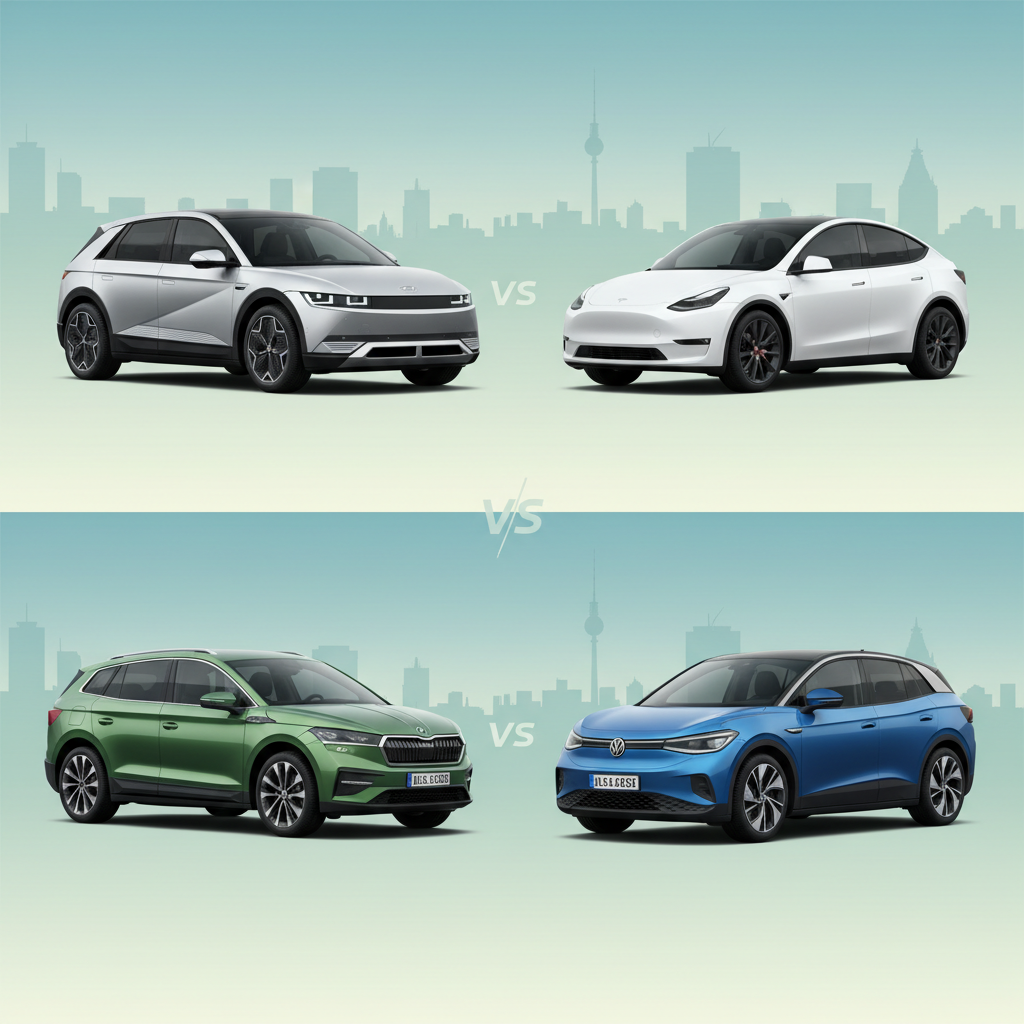
Two head to head matchups dominate EV comparison searches across the UK, Germany, France and the Netherlands in 2026, and neither is close on volume. In the compact electric SUV class the Hyundai Ioniq 5 and Tesla Model Y get cross shopped more than any other pair. In the family electric SUV class the Skoda Enyaq and Volkswagen ID.4 are the default match, partly because they share a platform and partly because Skoda has quietly become the volume leader in several EU markets.
This article runs both pairs through the same lens: real world range across mild, cold and motorway driving, charging speed and DC peak power, battery warranty, five year total cost of ownership using a Berlin home charging profile, and three year depreciation against German residual data. The data and the comparison views below are pulled directly from the Wise EV comparison tool.
Pair 1: Hyundai Ioniq 5 (2024, 84 kWh AWD) vs Tesla Model Y (2024, Performance)
Specifications and range
The Model Y Performance and Ioniq 5 AWD sit within €6,000 of each other on the German list, weigh almost the same, and use similar sized packs. The headline difference is the Hyundai's 800V architecture, which doubles its DC charging speed against the Tesla.
| Spec | Hyundai Ioniq 5 84 kWh AWD | Tesla Model Y Performance |
|---|---|---|
| Battery (usable) | 84 kWh | 82 kWh |
| Max DC charging | 260 kW | 250 kW |
| 10 to 80 percent (real world) | 18 min | 28 min |
| Architecture | 800V | 400V |
| Kerb weight | 2,085 kg | 2,054 kg |
| WLTP range | 460 km | 580 km |
| Mild weather range | 410 km | 530 km |
| Cold weather range | 300 km | 385 km |
| Highway range (110 km/h, 0 to 5C) | 345 km | 430 km |
| WLTP consumption | 18.8 kWh/100 km | 16.2 kWh/100 km |
| Real world consumption | 19.5 kWh/100 km | 17.2 kWh/100 km |
| Battery warranty | 8 years / 160,000 km, 70% capacity | 8 years / 192,000 km, 70% capacity |
| German list price (2024) | from €55,490 | from €60,990 |
The Model Y wins on every range scenario by 80 to 120 km. Tesla's efficiency advantage comes from a lower drag coefficient (0.22 in the 2024 update against the Ioniq 5's 0.288) and a smaller frontal area. Cold weather costs both cars roughly 27 percent of WLTP, which is normal for the segment.
The Ioniq 5 wins decisively on DC charging. 18 minutes from 10 to 80 percent against the Model Y's 28 minutes is a meaningful saving on a 1,000 km trip with two stops. Tesla's advantage at the network level (Supercharger reliability, plug and charge) often closes the gap in practice. If you do most of your long distance driving in countries where Supercharger access is dense (Germany, the Netherlands, the UK), the difference matters less than the spec sheet suggests.
Berlin total cost of ownership
We modelled a Berlin owner doing 15,000 km per year with a 70 percent home and 30 percent public charging split, dynamic Tibber or Ostrom overnight tariff averaging €0.18 per kWh, and Ionity or EnBW rapid charging at an average €0.59 per kWh.
| Annual cost | Hyundai Ioniq 5 AWD | Tesla Model Y Performance |
|---|---|---|
| Energy | €1,550 | €1,400 |
| Vehicle tax | €0 (EV exempt until 2030) | €0 (EV exempt until 2030) |
| Maintenance | €420 | €340 |
| Insurance (Berlin, 35yr driver, SF 10) | €600 | €760 |
| Parking permit | €420 | €420 |
| Total annual running cost | €2,990 | €2,920 |
Running costs are within €70 per year. The Tesla's lower energy and maintenance costs are almost exactly cancelled by its higher insurance premium, which sits well above class average because of high parts costs on the structural casting body. Five year running total: roughly €15,000 for either car.
The bigger swing is depreciation. Schwacke data for Germany puts the Model Y at 60 percent residual after three years on 45,000 km. The Ioniq 5 AWD lands at around 53 percent. Across the first three years that is roughly €4,200 in favour of the Tesla on a €55,000 to €60,000 list price.
Verdict on pair 1
If you do a lot of long distance driving and your home charging plan is uncertain, the Tesla wins on range, efficiency and residuals. If you have a fast home charger and value the Ioniq 5's interior space, faster DC charging and lower insurance, the Hyundai is the smarter buy at list. Either way you should run your own profile in the head to head view rather than rely on category averages.
Pair 2: Skoda Enyaq 85 (2025) vs Volkswagen ID.4 Pro (2025)
Specifications and range
This is the closest match in the EV market, by design. Both cars sit on the Volkswagen Group MEB platform, share their drivetrain, share their charging stack and share their 8 year battery warranty. The differences are body shape, interior philosophy, pricing and brand. The numbers reflect that.
| Spec | Skoda Enyaq 85 | Volkswagen ID.4 Pro |
|---|---|---|
| Battery (usable) | 82 kWh | 77 kWh |
| Max DC charging | 175 kW | 175 kW |
| 10 to 80 percent (real world) | 28 min | 28 min |
| Architecture | 400V | 400V |
| Kerb weight | 2,017 kg | 2,124 kg |
| WLTP range | 559 km | 524 km |
| Mild weather range | 460 km | 445 km |
| Cold weather range | 330 km | 320 km |
| Highway range (110 km/h, 0 to 5C) | 380 km | 370 km |
| WLTP consumption | 16.7 kWh/100 km | 16.3 kWh/100 km |
| Real world consumption | 17 kWh/100 km | 17 kWh/100 km |
| Battery warranty | 8 years / 160,000 km, 70% capacity | 8 years / 160,000 km, 70% capacity |
| German list price (2025) | from €46,900 | from €48,335 |
The Enyaq has a slight range advantage in every scenario, driven by the larger 82 kWh pack and 107 kg lower kerb weight. Cold weather range loss is 41 percent of WLTP on both cars, which is typical for the segment in central European winter conditions with the cabin heated to a normal setting.
DC charging is identical (175 kW peak, 28 minutes from 10 to 80 percent), which makes sense given the shared MEB stack. Neither car is class leading on charging speed (the Ioniq 5 in pair 1 charges roughly 40 percent faster), but both are predictable, and the VW Group has been pushing reliable charge curves through OTA updates since the 2023 software refresh.
One quirk that matters in 2026: the German EV grant launching in January 2026 caps eligible vehicles at €45,000 net list price. The Enyaq 85 base trim is right at that threshold and qualifies in some configurations. The ID.4 Pro Performance trim sits above it and does not. For a private buyer in Germany this is a €4,000 swing in favour of the Skoda before you negotiate.
Berlin total cost of ownership
Same Berlin profile: 15,000 km per year, 70 percent home and 30 percent public charging, dynamic overnight tariff, Ionity or EnBW for rapid.
| Annual cost | Skoda Enyaq 85 | Volkswagen ID.4 Pro |
|---|---|---|
| Energy | €1,300 | €1,250 |
| Vehicle tax | €0 (EV exempt until 2030) | €0 (EV exempt until 2030) |
| Maintenance | €450 | €500 |
| Insurance (Berlin, 35yr driver, SF 10) | €620 | €640 |
| Total annual running cost | €2,370 | €2,390 |
The two cars are within €20 per year on running costs. The Enyaq edges energy because of slightly better real world efficiency at the same consumption figure (the smaller frontal area in the Skoda body helps at motorway speeds). VW dealer service rates run marginally higher than Skoda dealer rates in most German cities, which closes the gap on maintenance.
Three year depreciation is where the Enyaq pulls away. DAT and Schwacke data through Q1 2026 puts Enyaq 85 residual at 53 percent after three years on 45,000 km. The ID.4 Pro lands at 46 to 49 percent depending on trim, partly because of VW's heavy fleet discounting on the ID.4 line which has dragged used prices.
In cash terms over three years that is roughly €2,000 to €3,500 in favour of the Skoda on a list price within €1,500 of the VW. For a private buyer this is the most consequential number on the page.
Verdict on pair 2
The mechanical case for either car is close to a coin flip. The financial case favours the Skoda on three counts: lower list price, eligibility for the 2026 German grant on base trims, and noticeably stronger residuals. The ID.4 wins back ground if you prefer the more modern dashboard, the optional augmented reality head up display, or a specific VW dealer relationship. For most private buyers on a five year horizon, the Enyaq is the smarter purchase.
How charging cost actually plays out on the road
A useful sanity check across all four cars: what does charging cost per 100 km look like in two realistic scenarios? Berlin dynamic overnight at €0.18 per kWh, and a Berlin to Munich motorway run on Ionity at €0.59 per kWh.
| Car | Real consumption | Home cost per 100 km | Rapid cost per 100 km |
|---|---|---|---|
| Hyundai Ioniq 5 AWD | 19.5 kWh | €3.51 | €11.51 |
| Tesla Model Y Performance | 17.2 kWh | €3.10 | €10.15 |
| Skoda Enyaq 85 | 17.0 kWh | €3.06 | €10.03 |
| Volkswagen ID.4 Pro | 17.0 kWh | €3.06 | €10.03 |
Two takeaways. First, the AWD performance trims (Ioniq 5 AWD, Model Y Performance) cost meaningfully more per kilometre at the rapid charger than the rear wheel drive family SUVs. Across a 1,000 km annual road trip the difference is roughly €15. Across 5,000 km per year of motorway driving, it is €75. Real money, but not enough to overturn other factors.
Second, all four cars are within roughly 14 percent of each other on per kilometre running cost on home charging. The decision should not hinge on a 30 cents per 100 km gap. It should hinge on which car fits your usage, your home charging situation, and your residual value risk tolerance.
Battery warranty and what it actually covers
All four cars carry the EU and UK standard 8 year / 160,000 km cover guaranteeing the battery retains at least 70 percent of original capacity. The Tesla Model Y Performance extends to 192,000 km, which matters for high mileage drivers (above 24,000 km per year).
Real world degradation data through 2026 from Geotab and Recurrent suggests all four packs degrade at 1.5 to 2 percent per year for the first three years and slow thereafter. A four year old Ioniq 5 or Model Y is typically at 90 to 93 percent of original capacity. Enyaq and ID.4 packs are slightly newer in fleet data, but early indicators line up with VW Group claims of similar degradation curves.
If you are buying any of these four used, ask the dealer for a state of health report pulled from the diagnostic port. Most VW Group, Hyundai and Tesla service centres can produce one in 20 minutes.
What this means for your shortlist
If your shortlist contains both a compact SUV and a family SUV, the four cars above probably cover 80 percent of what most EU and UK buyers are cross shopping in 2026. The right call depends on three questions you have to answer honestly:
How often do you actually do 600 km plus journeys? Twice a year favours the Enyaq or ID.4 (cheaper, less charging speed needed). Once a month favours the Tesla Model Y (range and Supercharger network). Two long trips a month favours the Ioniq 5 (fastest charging in this group by a wide margin).
Will you charge at home cheaply? If yes, all four cars beat any petrol equivalent comfortably. If no, the Tesla and the Ioniq 5 close the gap fastest because of better range per stop on the public network.
How sensitive are you to depreciation? If you plan to sell at three years, the Model Y and the Enyaq are the residual winners by clear margins. If you plan to keep the car for eight years or more, residuals matter less than warranty coverage and software update commitments.
The Wise EV comparison tool lets you replace our Berlin assumptions with your own postcode electricity tariff, your annual mileage and your real charging split. For Germany specific scenarios with grants, BIK and Schwacke residuals applied automatically, use the German comparison view. The methodology behind the cold weather, mild weather and motorway range figures is documented on the main Wise EV site.
Both pairs are close calls on paper. They stop being close calls once you put your own numbers in.
The verdict: one winner across all four cars
The honest answer for the typical European first time EV buyer in 2026 is the Skoda Enyaq 85.
It is not the fastest, it does not have the longest range, and it does not have the largest charging network. The Tesla Model Y beats it on every one of those metrics. What the Enyaq has is the financial profile that matters most to a buyer who has never owned an electric car before and is sensitive to getting the maths wrong.
Three numbers carry the case.
€46,900 list price puts the Enyaq 85 base trim below the €45,000 net cap on the new German 2026 EV grant, which means a €4,000 reduction at the point of purchase that none of the other three cars in this article can claim. France's bonus écologique and the Dutch RVO subsidy treat it the same way. On the UK list the entry trim sits inside the £37,000 cap for the £3,750 grant tier.
53 percent residual at three years on 45,000 km is the strongest value retention of any non Tesla EV in this comparison, and it is two to seven percentage points ahead of its mechanical sibling, the Volkswagen ID.4 Pro. On a list price within €1,500 of the VW, that is €2,000 to €3,500 of additional resale value at the end of year three.
€2,370 annual Berlin running cost is the lowest of the four cars, and it is achieved on a real world range that holds 330 km in cold weather and 380 km on the motorway. That covers 99 percent of the journeys a private European buyer actually makes.
The Tesla Model Y is the right answer for the buyer who covers more than 25,000 km per year, who values the Supercharger network as a reliability backstop, and who can absorb a higher list price for stronger residuals and longer real world range. For that profile it is unbeatable in this group.
The Hyundai Ioniq 5 is the right answer for the buyer who does multiple long road trips every month and treats 18 minute DC charging as a non negotiable. Its 800V architecture is genuinely class leading and remains so against the other three cars on this page.
The Volkswagen ID.4 is the car that loses this comparison. Not because it is a bad EV, it is not, but because its sister Skoda is the same car for less money with better residuals. Pick the ID.4 only if you have a specific reason: a VW dealer relationship, a preference for the dashboard layout, or an existing fleet contract.
Across the broader field, the Enyaq wins on value retention plus running cost plus grant eligibility, and that combination is what most first time buyers should optimise for. Plug your own profile into the Wise EV comparison tool to confirm it for your specific case. The numbers usually agree.