EV vs Diesel Total Cost of Ownership: Cheaper Within 3 Years
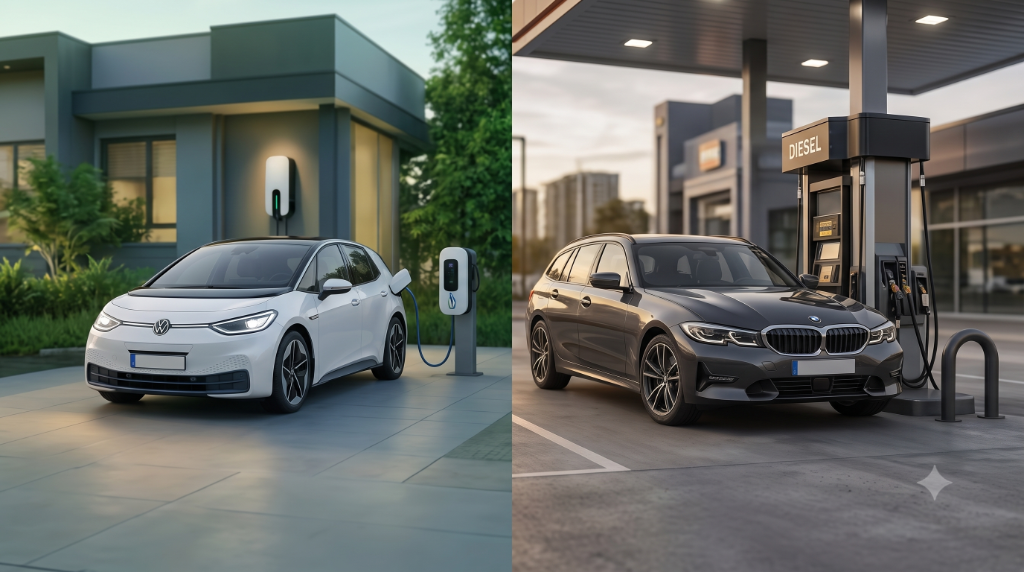
Most buyers look at the purchase price and stop there. That mistake costs thousands over the life of the car. An EV's total cost of ownership includes fuel, maintenance, insurance, depreciation and tax — and when you add all of it up, an electric car comes out cheaper than an equivalent diesel within two to four years in most UK driving profiles. The fleet data is clear on this, and this article breaks it down line by line so you can decide with real numbers in front of you.
Table of contents
- Quick summary
- What TCO is and why it matters more than the sticker price
- The line items in an EV's TCO
- The line items in a diesel's TCO
- Head to head: EV vs diesel over 3 years
- When the EV does not win yet
- How to calculate your own TCO
- FAQ
- References
Quick summary
| Key fact | Explanation |
|---|---|
| The purchase price is not the real cost | TCO adds fuel, maintenance, insurance, depreciation and tax. An EV can cost more to buy and less to own. |
| Energy saving is the biggest TCO driver | Charging an EV costs roughly 60–75% less per mile than filling a diesel at current UK energy prices — far more if you charge overnight on an EV tariff. |
| EV maintenance is structurally cheaper | No oil changes, no cam belt, no clutch. Workshop costs for an EV run about 30–40% lower than a diesel. |
| The new Electric Car Grant lowers the entry price | The UK Electric Car Grant cuts up to £3,750 off eligible new EVs priced at or under £37,000. |
| Diesel depreciation is accelerating | Clean air zones and the 2035 new-petrol-and-diesel phase-out are depressing residual values on diesels. |
| Break-even usually arrives before 3 years | For drivers above ~10,000 miles a year with home charging, the EV recovers the price gap in 24–36 months. |
| Your usage profile decides the outcome | Home-charging drivers gain the most. The EV case is weaker for low-mileage drivers who rely only on public rapid charging. |
What TCO is and why it matters more than the sticker price
TCO (Total Cost of Ownership) is the sum of every cost tied to a car over a defined period, usually 3 to 5 years. It is not an academic concept: it is the metric company fleets use to decide which cars they buy, and it is exactly what you should use to compare an EV with a diesel.
The problem is that the market shows you the list price and the dealer talks about the monthly payment. Neither gives you the full picture. A car that is cheaper to buy can be significantly more expensive to run, and vice versa.
In practice, TCO covers six big blocks: purchase price net of grants, energy cost, maintenance and repairs, insurance, taxes and charges, and depreciation. The usual trap is ignoring depreciation, which accounts for 35–50% of the total cost of ownership on mid-range cars over the first three years.
Tip: When you use a comparison tool like Wise EV to weigh EV models against their post-2019 diesel equivalents, always look at the estimated 3-year residual value. That single number changes the final result dramatically.
The line items in an EV's TCO
Purchase price net of incentives
A C-segment EV costs roughly £32,000–£40,000 in the UK in 2026. The Electric Car Grant, launched in July 2025, takes up to £3,750 off eligible cars priced at or under £37,000 (a smaller band gets up to £1,500), and the discount is applied at the dealer — no separate application. Combined with manufacturer and dealer offers, the effective price often lands several thousand pounds below list.
Energy cost per mile
A typical EV (around 17 kWh/100 km, or ~3.7 mi/kWh) costs about 3–4p per mile charging at home on an off-peak EV tariff such as Intelligent Octopus Go at roughly 7p/kWh. The same mile in a diesel using 5.5 L/100 km at ~£1.72/litre works out near 15p per mile. Even on the standard price-cap rate (~24.7p/kWh in mid-2026), home charging stays far cheaper than diesel. Over 12,000 miles a year, that gap is hundreds of pounds.
Maintenance and repairs
European corporate fleet data published by ACEA shows BEV maintenance running 30–40% below an equivalent combustion car. There is no oil, no oil filter, no spark plugs, no cam belt and no clutch. The main costs are tyres, brake pads (which last longer thanks to regenerative braking) and the air-conditioning service.
Depreciation
EV depreciation was a serious problem between 2019 and 2022. Since 2023 the picture has improved: models like the Tesla Model 3, Renault Megane E-Tech and Volkswagen ID.4 hold roughly 55–65% of their value at three years on the European used market. Equivalent diesels retain 45–55%, and trending down as clean air zones spread.
The line items in a diesel's TCO
A post-2019 C-segment diesel has an average purchase price of £25,000–£33,000. With no purchase grant equivalent to the EV's, the effective price is essentially the list price. Fuel at current prices is the largest running cost, and maintenance — though lower than petrol — adds the complexity of the exhaust after-treatment system (the DPF particulate filter and AdBlue on Euro 6d cars).
A common mistake buyers make is underestimating the DPF. A forced regeneration at a workshop can cost £130–£260, and replacing the particulate filter runs £700–£1,800 depending on the model. For urban drivers who rarely cover more than 12 miles at a stretch, the DPF does not regenerate properly in normal use and the problem appears before 50,000 miles.
Diesel depreciation is the least discussed factor and the one changing fastest. London's ULEZ, plus clean air zones in Birmingham, Bristol, Sheffield and others, restrict or charge older diesels, shrinking the pool of second-hand buyers and depressing residual values structurally, not cyclically.
"The residual value of diesel vehicles in Europe fell by an additional 8% on average between 2021 and 2023, above historical depreciation, due to regulatory uncertainty in low-emission zones." (Eurotax Glass's report, 2023)
Head to head: EV vs diesel over 3 years
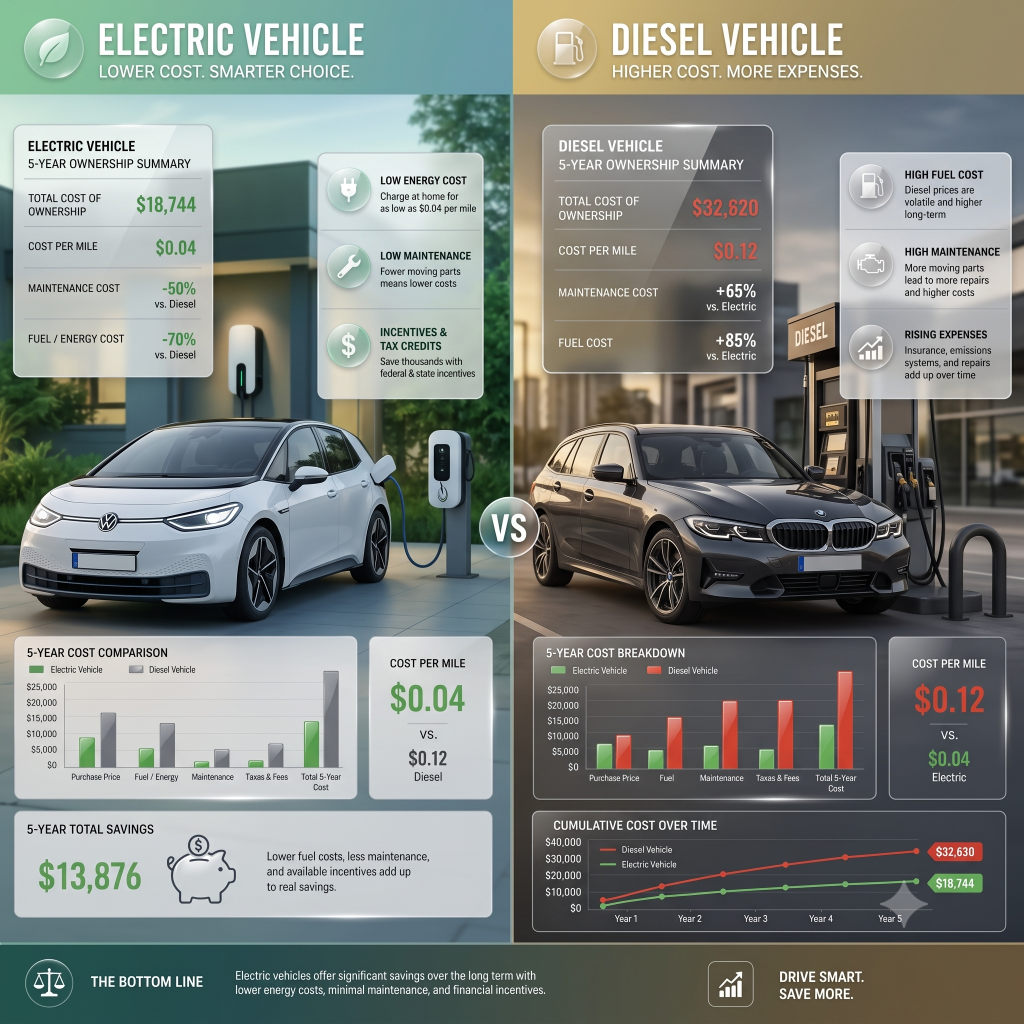
The table below compares the 3-year TCO of a representative C-segment EV and diesel for a driver covering 12,000 miles a year (≈20,000 km) with access to home charging. Figures are conservative illustrative estimates based on 2026 UK market data — use them as a model, not a quote.
| TCO component | EV (C-segment, 12k mi/yr) | Diesel (C-segment, 12k mi/yr) |
|---|---|---|
| Purchase price net of grant | £32,000 (with Electric Car Grant) | £28,000 (no incentive) |
| Energy (3 years, 36k mi) | £1,650 (mixed home/public) | £5,280 (diesel at ~£1.60/L) |
| Maintenance (3 years) | £800 | £1,600 |
| Insurance (3 years) | £2,400 | £2,100 |
| Road tax (VED, 3 years) | £400 | £600 |
| Residual value at 3 years (≈58% / 50%) | –£20,700 (recovered on sale) | –£14,000 (recovered on sale) |
| Total 3-year TCO | £16,550 | £23,580 |
The result speaks for itself: the EV costs about £7,000 less than the diesel over 3 years at 12,000 miles a year with home charging. That gap widens the more miles you drive and the cheaper your overnight charging rate.
Tip: Before you sign anything, use the Wise EV comparison tool to enter your real usage (annual mileage, the charging you actually have access to, and your region) and get a TCO estimate fitted to your situation, not to statistical averages.
When the EV does not win yet
Being honest with the data is part of a reliable analysis. There are situations where an EV's 3-year TCO does not beat a diesel, and it pays to identify them precisely.
Drivers who rely entirely on public charging
If you have no off-street parking and depend 100% on public AC chargers or motorway DC rapid chargers, your cost per mile climbs sharply — public rapid charging can run 60–80p/kWh. That halves the energy saving or wipes it out. In that scenario the break-even stretches to 4 or 5 years.
Very low annual mileage
Below ~6,000 miles a year, the fuel and maintenance saving is not enough to recover the purchase-price gap in 3 years. Break-even moves out to 4–6 years. The exception is drivers in cities with clean air zone charges, where avoiding the daily diesel charge adds real value.
Buyers with no access to incentives
The Electric Car Grant only applies to eligible models at or under £37,000. If the EV you want sits above that cap or is not on the eligible list, the effective price rises and break-even shifts 6–12 months further out.
How to calculate your own TCO
TCO is not hard to calculate if you have the right inputs. The process I recommend has five concrete steps.
First, set the time horizon. Three years is the minimum useful window for an EV-versus-diesel comparison. Five years gives a fuller picture for buyers who keep cars longer.
Second, get the net purchase price. For the EV, subtract every incentive you can actually access (Electric Car Grant, manufacturer discount, dealer offer). For the diesel, use the list price with the discount you can realistically negotiate.
Third, estimate the energy cost using your real mileage and your real charging tariff or local diesel price. Do not use national averages if your conditions differ.
Fourth, check the expected residual value of the specific model you are evaluating. Tools like the Wise EV calculator let you compare EV and ICE models built from 2019 onward with up-to-date market data, giving you a firmer basis than generic dealer estimates.
Fifth, add local taxes and charges. VED now applies to EVs too (see the FAQ), and clean air zones add an implicit cost to older diesels that few calculators capture automatically.
Tip: A frequent mistake is calculating TCO using today's fuel price rather than a 24-month average. UK diesel has swung between roughly £1.45 and £1.90 a litre in recent years. Using an artificially low price flatters the diesel.
FAQ
Is an EV's total cost of ownership always lower than a diesel's?
Not always, but in most common UK usage profiles, yes. Drivers above ~10,000 miles a year with home charging reach break-even before 3 years. Someone driving under 6,000 miles a year or relying entirely on public charging may not get there until year 4 or 5.
How does the EV battery affect long-term TCO?
Battery degradation worries first-time buyers most, but fleet data from Tesla, Renault and Hyundai shows batteries in cars built from 2019 retaining 85–92% of original capacity at 100,000 miles. An out-of-warranty replacement is expensive (£4,000–£13,000 depending on model), but that scenario is not representative in a 3- or 5-year TCO, given the 8-year battery warranties most makers offer.
Is EV insurance more expensive than diesel?
In 2026, slightly, yes. EV repair costs are higher because front-end damage can affect the battery pack. But the premium is typically £150–£300 a year — a small fraction of the fuel and maintenance saving.
Do electric cars pay road tax in the UK now?
Yes. Since 1 April 2025, zero-emission cars pay Vehicle Excise Duty. A new EV pays a £10 first-year rate, then the standard rate (£200 a year from April 2026) from year two. EVs priced over £50,000 also pay the Expensive Car Supplement for years two to six. EVs are no longer road-tax-free — factor this into your TCO.
Which tools let me compare an EV's TCO with a specific diesel?
Wise EV compares EV and ICE models built from 2019 onward with real technical and cost data. It is one of the few platforms specialising in direct EV-versus-ICE comparison with filters by segment, year and usage type, unlike generalist tools not optimised for the European market.
Will diesel depreciation keep accelerating?
The signs point that way. Euro 7, the spread of clean air zones across major European cities, and the UK's plan to end new petrol and diesel car sales are shrinking the pool of future buyers for used diesels. That risk is not captured in historical depreciation tables.
Have you calculated the TCO of your next car yet? Tell us which model you are comparing and what result you get — real numbers from other buyers help the whole community decide better.
Note: This is an educational cost analysis, not financial advice. Figures are illustrative estimates based on 2026 market data and will vary by model, region, tariff and driving profile. Verify current prices and grant eligibility before you buy.