WLTP vs Real-World EV Range: Why You Get Less
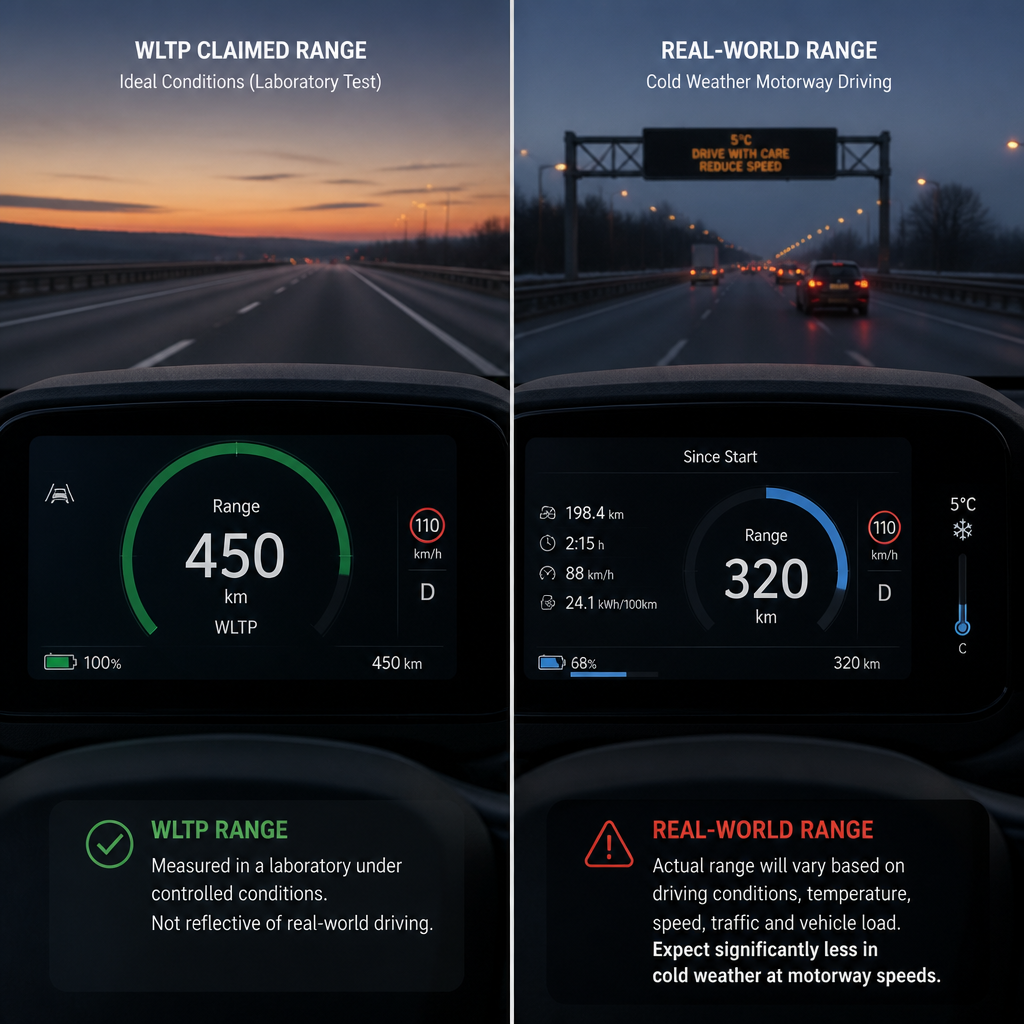
You pick an electric vehicle with a 450 km WLTP range, charge it to 100%, and head out on a cold December motorway. By the time you reach 320 km on the trip computer, the car is warning you to find a charger. That gap, roughly 29% short of the official figure, is not a malfunction. It is the predictable result of a certification test that was never designed to replicate your actual driving conditions. If you are researching an EV purchase, comparing models side by side, or trying to understand why the number on the window sticker rarely matches the number on the road, this guide will tell you exactly why that gap exists, how large it typically is, and what you can do about it when you ev compare models before buying.
Table of Contents
- What Is WLTP and How Is the Test Actually Run?
- How Big Is the Real-World Range Gap?
- Why the Gap Exists: The Five Main Culprits
- WLTP vs NEDC vs Real-World: A Practical Comparison
- How to Use WLTP Figures to Make a Smarter EV Purchase
- How to Maximise Your Real-World Range
- Frequently Asked Questions
- References
What Is WLTP and How Is the Test Actually Run?
WLTP stands for Worldwide Harmonised Light Vehicle Test Procedure. It replaced the older NEDC (New European Drive Cycle) as the mandatory range and efficiency certification method for vehicles sold in the EU and UK. The switch was a genuine improvement: WLTP uses more varied speed phases, a longer test distance, and heavier optional equipment weighting than NEDC ever did.
But the test is still conducted in a laboratory, on a chassis dynamometer (a roller rig), not on public roads. The conditions are tightly controlled: a constant ambient temperature of 23 degrees Celsius, no wind resistance beyond what the roller generates, no hills, no real-world traffic, and crucially, cabin climate systems (heating and air conditioning) are turned off. The average test speed sits at around 46.5 km/h, far below typical motorway cruising.
That last point is where the official figure and your commute start to diverge sharply.
A WLTP figure never exists simply "for a model." It exists for a specific version, with a specific wheel size, in a specific model year. The same car can show 614 km in rear-wheel drive on 18-inch wheels and 519 km with all-wheel drive. Same name on the bonnet, 95 km apart.
This means that when you ev compare two vehicles using only their headline WLTP numbers, you could be comparing figures derived from different configurations of the same underlying car. Trim level, wheel size, and optional equipment all feed into the certified figure and can shift it by double digits.
How Big Is the Real-World Range Gap?
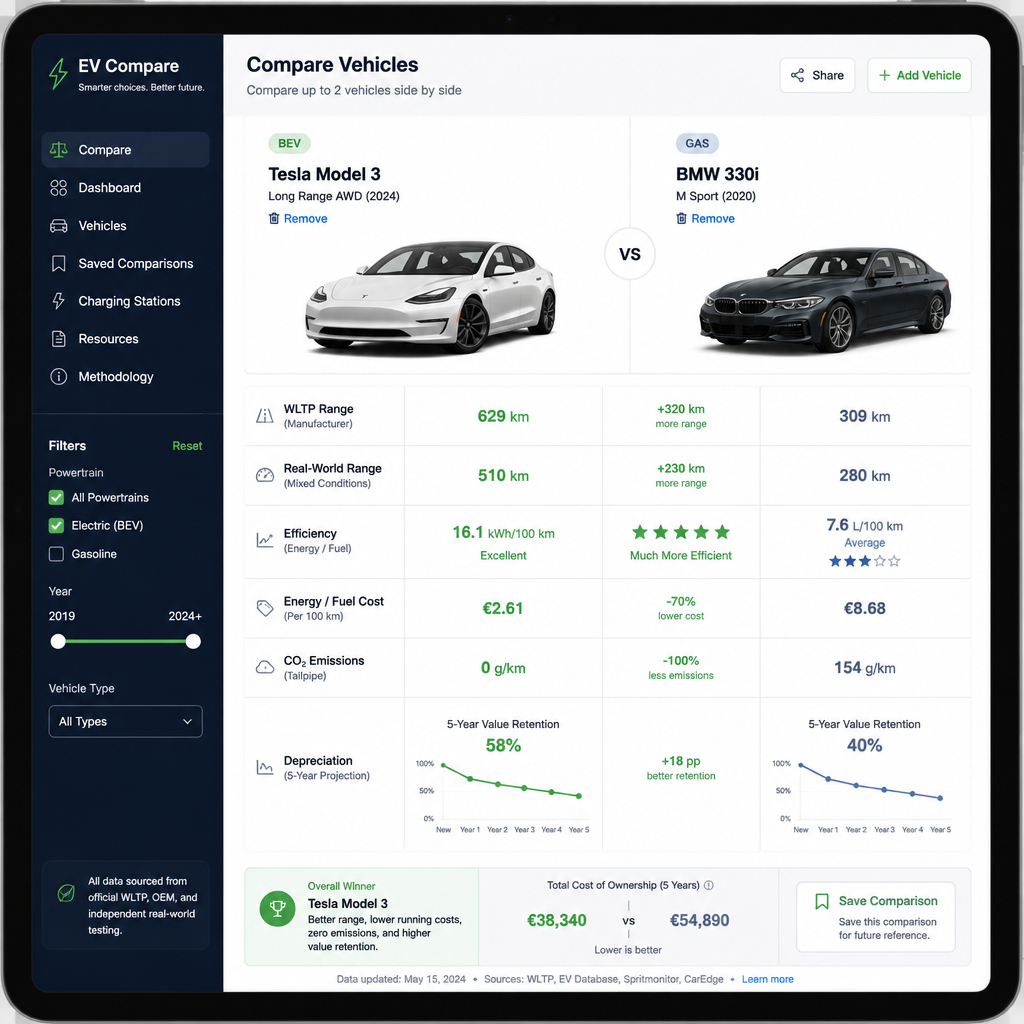
The short answer: plan on getting 10 to 20 percent less than the WLTP figure in ordinary mixed driving. In winter motorway conditions, that gap widens to 30 percent or more. These are consistent findings across independent real-world tests and owner-reported data across Europe.
Typical range deficit by driving scenario
Mixed everyday driving in mild weather tends to produce a 10 to 20 percent shortfall against the WLTP rating. Motorway-only driving, even in moderate temperatures, frequently lands 15 to 25 percent below the stated figure because sustained high speeds drain the battery far faster than the test cycle's moderate average speed implies. Cold weather compounds the problem significantly: at sub-zero temperatures with cabin heating running, many owners report real-world range landing 30 to 35 percent below WLTP.
To put that in concrete terms: a car rated at 500 km WLTP could realistically deliver 330 to 380 km on a cold winter motorway run. That is not a fault in the vehicle. It is simply what the physics and the test protocol produce together.
Pro tip: When comparing EV models on Wise EV, check the real-world range data alongside the WLTP figure. A car with a slightly lower WLTP number but stronger real-world performance in cold conditions can easily outperform a rival with a bigger headline range in everyday European winter driving.
Why the Gap Exists: The Five Main Culprits
Understanding the specific reasons the gap opens up lets you predict it for the conditions you actually drive in, rather than applying a blanket discount to every figure.
1. Speed and aerodynamic drag
Aerodynamic drag increases with the square of speed. At 70 mph (113 km/h) on a UK motorway or 130 km/h on a German autobahn, the energy cost per kilometre is dramatically higher than at the 46.5 km/h average the WLTP test uses. This is the single biggest driver of real-world range shortfall for drivers who regularly use motorways.
2. Temperature and battery chemistry
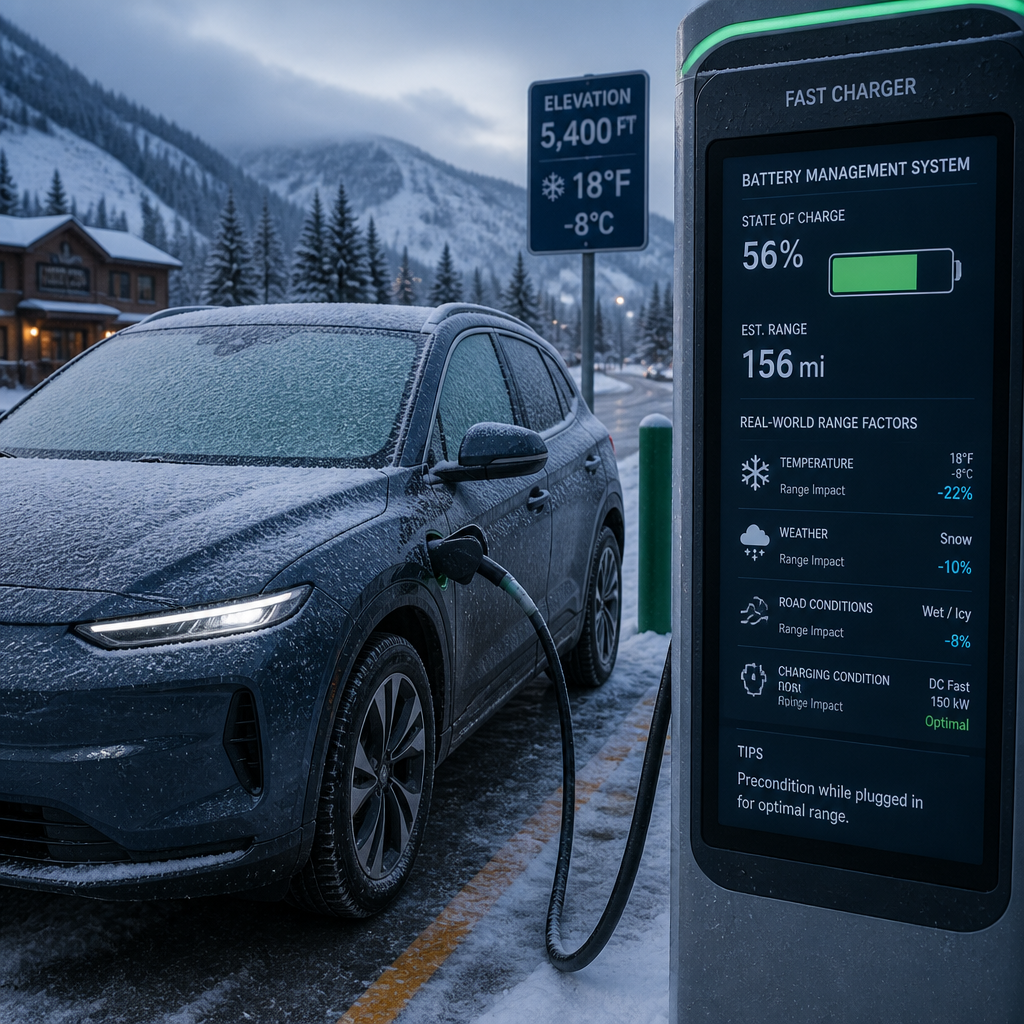
The WLTP test runs at a steady 23 degrees Celsius. In winter across northern and central Europe, that temperature is rarely seen. Cold temperatures slow the electrochemical reactions inside lithium-ion cells, reducing the energy the battery can deliver. Battery management systems also deliberately restrict output in the cold to protect the cells, further cutting available range.
3. Cabin heating and air conditioning
Climate control is switched off during WLTP testing. In reality, heating a cold cabin in winter is one of the largest energy draws in an EV, because unlike a petrol engine there is no waste heat to redirect from a combustion process. Running the heater on a cold day can subtract 10 to 20 percent from your usable range on its own.
4. Wheel size and tyre choice
Larger wheels increase rolling resistance and worsen aerodynamics. The WLTP figure used in marketing is often taken from the most efficient wheel and tyre configuration. If you buy the car with larger alloys, your real-world range will be lower than the published number even in perfect conditions.
5. Load and accessories
Passengers, luggage, roof boxes, and tow bars all add weight and drag. A car tested empty with a light configuration will always return a better figure than the same car loaded for a family trip.
WLTP vs NEDC vs Real-World: A Practical Comparison
To understand where WLTP sits in the landscape of EV range certification, it helps to see how it compares to the test it replaced and to actual measured performance.
Metric
NEDC (Legacy)
WLTP (Current EU/UK Standard)
Real-World Driving
Test environment
Laboratory roller rig
Laboratory roller rig
Public roads, variable conditions
Ambient temperature
20 to 30°C
Fixed 23°C
Seasonal, often well below 23°C
Average test speed
Approx. 34 km/h
Approx. 46.5 km/h
Mixed, often 80-130 km/h on motorways
Climate control used?
No
No
Yes, especially in winter and summer
Typical real-world gap
30 to 50% optimistic
10 to 30% optimistic
Baseline (actual performance)
Mandatory for EU/UK sales?
Phased out, replaced by WLTP
Yes
Not certified
The shift from NEDC to WLTP was a meaningful improvement. WLTP results are roughly 22 percent less optimistic than equivalent NEDC figures, which is a significant correction toward reality. But the 10 to 30 percent real-world gap that still persists under WLTP shows how much work remains when lab conditions and road conditions diverge.
Pro tip: When browsing older EV listings that still show NEDC figures, mentally apply an extra correction before comparing against current-generation cars certified under WLTP. A direct number-to-number comparison between NEDC and WLTP figures is not a fair ev compare and will likely mislead your decision.
How to Use WLTP Figures to Make a Smarter EV Purchase
WLTP figures are not useless. They are the only standardised measure you have for making like-for-like comparisons between models, and they serve that purpose well when you treat them correctly.
Use WLTP as a relative ranking, not an absolute promise
If Car A has a 520 km WLTP rating and Car B has a 420 km WLTP rating, Car A almost certainly has longer real-world range too, assuming similar vehicle types and conditions. The ranking holds even if neither car delivers its exact claimed figure. What the number cannot tell you is precisely how many kilometres you will get on a specific route in January.
Apply a consistent real-world discount
For planning purposes, apply a 20 percent discount to the WLTP figure for mixed driving, and a 30 percent discount for winter motorway journeys. A car rated at 400 km WLTP should be planned around 280 to 320 km in real cold-weather motorway use. This is conservative enough to keep you away from range anxiety without being so pessimistic that it distorts your evaluation of genuinely capable vehicles.
Check configuration-specific figures
Always check which exact configuration the WLTP number comes from. Wheel size, drivetrain layout (front-wheel drive, rear-wheel drive, all-wheel drive), and battery tier all produce different certified figures. When you ev compare models on a tool that shows real-world range data alongside WLTP figures, you get a much more accurate picture of what ownership actually looks like.
Wise EV's real-world range analysis is built specifically for this kind of comparison, letting European buyers see side-by-side data that goes beyond the manufacturer's headline number.
How to Maximise Your Real-World Range
Knowing why the gap exists points directly to strategies that close it. None of these tips require any modification to the car.
Preheat the cabin while still plugged in
This is the single highest-value habit for winter EV driving. When you preheat the cabin using grid electricity before unplugging, you warm the battery and the interior without drawing from the drive range. This can save 5 to 10 percent of your usable range on a cold morning commute. Most modern EVs allow scheduled preheating from a smartphone app.
Reduce motorway speed where practical
Dropping from 130 km/h to 110 km/h on a motorway produces a disproportionate range benefit because aerodynamic drag falls sharply at lower speeds. On a long journey, this adjustment alone can add meaningful distance to your real-world range.
Use seat heaters rather than cabin blowers
Seat heaters warm the occupant directly and consume far less energy than heating the entire cabin air volume. In cold weather, using seat heaters as the primary heat source and keeping the cabin temperature setting lower extends real-world range noticeably.
Maintain tyre pressure
Under-inflated tyres increase rolling resistance, and rolling resistance is one of the energy costs that compounds over every kilometre. Checking tyre pressure regularly, especially before long trips, is a simple and consistent way to stay closer to the car's efficiency ceiling.
Use regenerative braking actively
Strong regenerative braking settings recover energy on deceleration that would otherwise be lost as heat. In urban and suburban driving with frequent speed changes, this can materially improve the effective range compared to coasting or using friction brakes.
For a full breakdown of how specific models perform across these conditions, the Wise EV ownership cost calculator and real-world range tool gives European buyers verified comparison data across EV and ICE models side by side.
Frequently Asked Questions
Is the WLTP range figure the distance I will actually get on a full charge?
No. The WLTP figure is a certified measurement under controlled laboratory conditions. In real-world driving, most owners get 10 to 20 percent less in mild mixed conditions, and up to 30 percent less in cold motorway conditions. Treat it as a ceiling that defines relative performance between models, not a guarantee of what you will see on your own routes.
Why does motorway driving reduce EV range so much more than city driving?
Aerodynamic drag rises with the square of speed. At motorway speeds of 110 to 130 km/h, an EV expends far more energy per kilometre than at the moderate average speeds in the WLTP test cycle (around 46.5 km/h). City driving, despite frequent stops, can actually return better real-world efficiency than motorway driving because regenerative braking recovers energy at every deceleration.
How much does cold weather reduce EV range in Europe?
Cold temperatures affect EV range through two separate mechanisms: reduced battery efficiency due to slower electrochemical reactions, and increased energy draw from cabin heating. Together, these factors can reduce real-world range by 30 to 35 percent on cold motorway journeys in northern and central European winters, compared to the WLTP figure certified at 23 degrees Celsius with no climate control.
Does the WLTP figure change if I buy a car with larger wheels?
Yes. Manufacturers must certify each wheel and tyre configuration separately, and larger wheels produce a lower certified WLTP figure because they increase rolling resistance and aerodynamic drag. The headline WLTP figure you see in advertising is often from the most efficient configuration. If you choose larger alloys, your car's official certified range will be lower, and so will your real-world experience.
How should I ev compare two electric vehicles if their WLTP figures are close together?
When WLTP figures are close, look at real-world range data, battery chemistry, and thermal management capability. A car with a marginally lower WLTP rating but superior cold-weather battery management can outperform a rival in winter conditions that are common across most of Europe and the UK. Side-by-side comparison tools that include real-world range data, ownership costs, and configuration-specific figures give you a far more reliable basis for this kind of decision than headline WLTP numbers alone.
Is WLTP more accurate than the old NEDC standard?
Significantly more accurate. WLTP test results are roughly 22 percent less optimistic than the NEDC figures they replaced, thanks to higher average test speeds, a longer test distance, and better weighting for optional equipment. The real-world gap that remains under WLTP is still real, but it is considerably smaller than the gap that existed when manufacturers were advertising NEDC-certified ranges.
Have you experienced a larger or smaller gap than expected between your EV's WLTP figure and your real-world range? Share your experience in the comments below.
References
- WLTP vs real-world EV range: how to calculate actual driving distance
- WLTP range versus winter range in cold European conditions
- Electric car range in 2026: how far can EVs really travel?
- What is WLTP electric car range and fuel economy: figures explained
- Why your EV will not hit its WLTP range and what that actually means