Winter Range: How Much You Really Lose, by Model and by Country
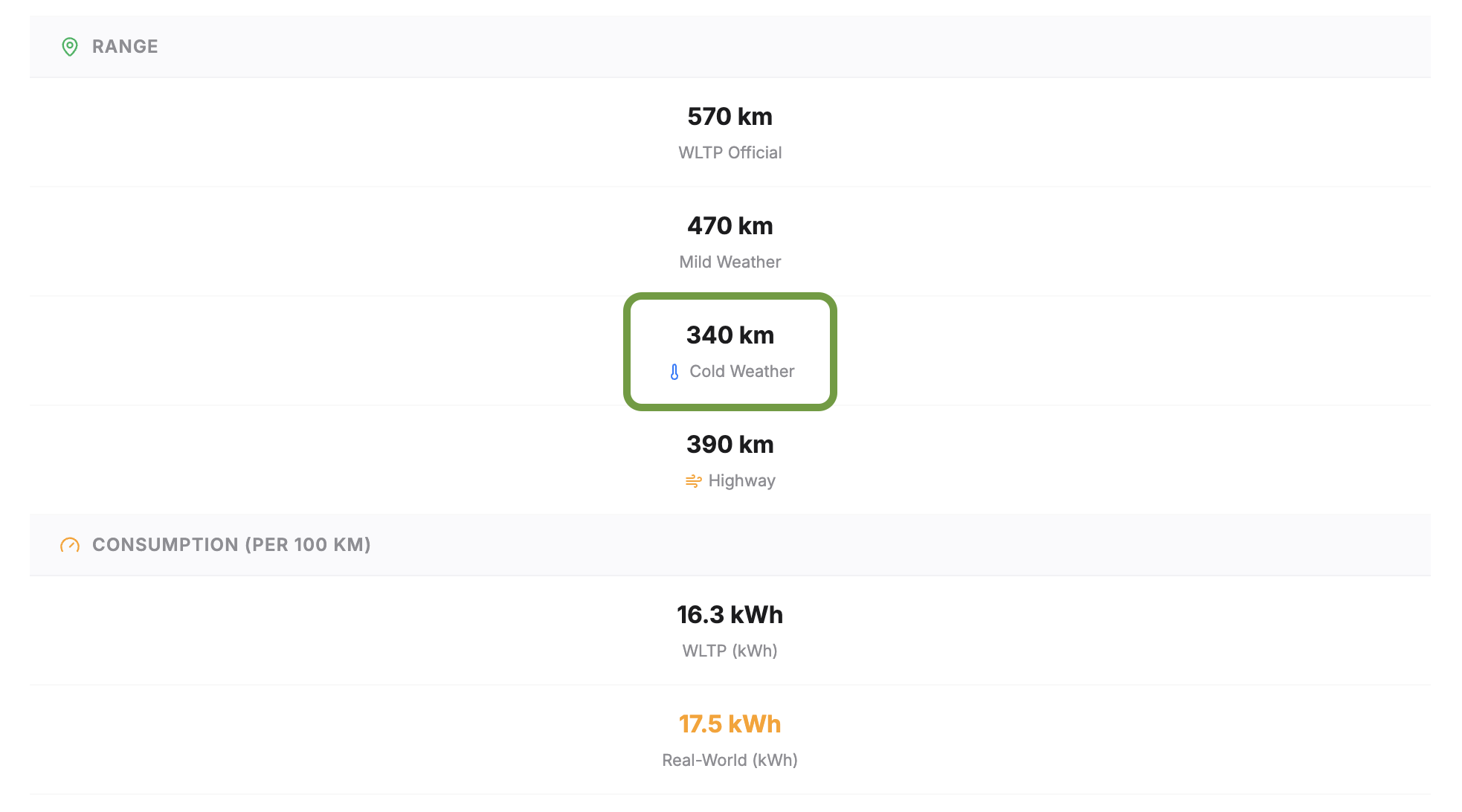
Every EV loses range in the cold. What almost nobody tells you is that the size of the loss depends far more on how cold it actually gets than on which car you buy. Norway's motoring club NAF proved that by accident: they ran the same test, on the same road, two winters running. In 2025, at temperatures between minus 6 and plus 8 degrees, the average car came in 18% under its official WLTP range. In 2026, at minus 7 to minus 32 degrees, the average car came in 38% under. Same test, same method, roughly double the loss. Ask how much this car will lose in your winter.
Table of contents
- The quick version
- What the winter tests actually measured
- Temperature, not season, is the variable
- What your country's winter really costs you
- Why the range databases will not rank cars for you
- Heat pumps: real, and smaller than you think
- Preconditioning is the biggest free win
- Charging in the cold
- What this means if you are buying used
- FAQ
- References
The quick version
| Test | Conditions | What it found |
|---|---|---|
| NAF El Prix, Jan 2026 | −7°C to −32°C, 24 cars | 38% average below WLTP; 9 of 24 lost 40% or more |
| NAF El Prix, 2025 | −6°C to +8°C | 18% average below WLTP |
| ADAC winter test, Jan 2026 | 0°C, motorway, 582 km | 22.2 to 35.3 kWh/100 km across 14 cars |
| ADAC test track | 0°C vs +20°C, same car | 21% to 30% more energy per km |
| Green NCAP, Nov 2025 | −7°C vs warm, mixed driving | Range down 26% to 36%; petrol benchmark used 6.7% more fuel |
| Green NCAP preconditioning | VW ID.4 Pure at −7°C | 46 km more mixed range, 79 km more urban range |
Two numbers to carry around: in a normal western European winter, expect to lose roughly a quarter to a third of your mild-weather range. In genuinely hard frost, below about minus 15, expect to lose closer to half.
What the winter tests actually measured
There are three serious European datasets and they measure different things, which is why their headline numbers disagree.
NAF El Prix drives real cars on real Norwegian roads until they stop. The January 2026 edition took 24 cars from Oslo up through Lillehammer and Dombås at minus 7 down to minus 32, and compared what each achieved against its WLTP figure. The best two were 29% under, with the Hyundai Inster managing 256 km against a rated 360 km. The worst was 46% under: the Lucid Air Grand Touring did 520 km against a rated 960 km. NAF said they had never recorded larger deviations from official range.
ADAC's winter test, published 22 January 2026, is stricter about control. ADAC recorded a real diesel drive from Munich to Berlin (582 km, 111 km/h average) and replayed that exact speed and elevation profile on a dynamometer at 0°C, with cars soaked at 0°C for 14 to 18 hours first. Heating ran in auto mode to a cabin target of 20 to 23°C at head height. Battery preconditioning for fast charging was left off, which is what happens to most drivers most of the time. Consumption ran from 22.2 kWh/100 km for a Tesla Model Y up to 35.3 for a BYD Sealion 7. In range terms: 441 km for the Audi A6 Avant e-tron performance, 406 km for the Model Y, 360 km for a Volvo EX90, 351 km for a BMW i5 Touring and 293 km for the Sealion 7.
Green NCAP isolates temperature properly, because it runs the same car warm and at minus 7. In its 6 November 2025 round the Dacia Spring went from 180 km mixed to 133 km, the Hyundai Inster from 322 to 219, and the VW ID.4 Pure from 304 to 196: 26%, 32% and 36% of range gone. The same round used a petrol SEAT Ibiza as a control, which went from 6.0 to 6.4 l/100 km, a penalty of 6.7%. Petrol cars lose efficiency in the cold too, about a fifth as much, because their engine wastes enough heat to warm the cabin for free.
One caution on ADAC's own figures. Their winter test is a motorway run at 0°C; their standard consumption test is a mixed cycle at unstated temperature. Comparing the two for the same car gives you cold plus motorway speed, not cold alone. A Tesla Model Y goes from 16.4 kWh/100 km standard to 22.2 in the winter test (plus 35%), a Kia EV6 from 18.6 to 27.0 (plus 45%), a Hyundai Ioniq 5 from 18.7 to 26.5 (plus 42%). Real gaps, and exactly what a winter motorway trip costs you, but not pure temperature effects.
Temperature, not season, is the variable
The NAF pair is the cleanest evidence in this whole subject. Same organisation, same route, same method, one year apart. Minus 6 to plus 8 gave 18% loss. Minus 7 to minus 32 gave 38%.
Three things happen as the thermometer drops, and only one of them is about the battery.
Cabin heating is the big one. Warming a cabin from minus 10 to plus 21 takes real energy, and unlike a combustion car there is no waste heat to do it for free. A resistive heater can pull 3 to 5 kW when it first comes on, comparable to what the wheels draw at 100 km/h.
Battery chemistry is second. Lithium-ion cells move ions more slowly when cold, so internal resistance rises, usable capacity drops, and regenerative braking is limited or switched off until the pack warms. You lose the energy you would normally recover on every descent and every roundabout.
Everything else is drag: denser cold air, winter tyres, snow and slush. Small individually, not trivial together.
City driving suffers more than motorway driving because of the first factor. Heating draws roughly constant power, so the slower you go, the more of it you spend per kilometre. Across the models we checked, EV Database's cold city figures are down about a third from mild weather, its highway figures about a fifth.
What your country's winter really costs you
This is where a single European average becomes useless. Here is what the five markets we cover actually experienced in winter 2025/26, using each country's own national weather service.
| Market | Winter 2025/26 mean (Dec to Feb) | Coldest recorded that winter | Realistic range loss |
|---|---|---|---|
| Spain | 7.6°C (mainland) | −14.0°C, Molina de Aragón, 6 Jan | Around 20% on the coast, more inland |
| UK | 4.94°C | Not published in the seasonal assessment | Around 25% |
| France | +1.7°C above the 1991 to 2020 normal | Not published in the seasonal bilan | Around 25% |
| Germany | 1.8°C | −21.7°C, Oberstdorf, 6 Jan | Around 30%, more in the south |
| Ukraine | Not published by the state service in a form we could verify | Not verified | 30% to 40% in a hard winter |
Two gaps in that table we are not going to paper over. Météo-France published winter 2025/26 as an anomaly (+1.7°C on the 1991 to 2020 reference) without an absolute national mean in the same bilan, so we have not invented one. For Ukraine we could not retrieve a verified retrospective seasonal summary, so that row is an estimate from owner reports rather than a measurement.
The table makes the point the averages hide. Spain's mainland mean of 7.6°C sounds like winter barely happens, and on the Mediterranean coast it nearly does not. Molina de Aragón hit minus 14.0°C on the same January morning that Oberstdorf in Bavaria hit minus 21.7°C. A Madrid commuter and a Málaga commuter do not own the same car, in range terms, even if they bought the same car.
Why the range databases will not rank cars for you
We checked six used models on EV Database, which publishes a cold-weather range (defined as minus 10°C with heating on) alongside a mild-weather range (23°C, no air conditioning). Here is the combined figure for each.
| Model | Mild range | Cold range | Loss | Heat pump |
|---|---|---|---|---|
| Hyundai Kona Electric 64 kWh (MY20-21) | 450 km | 325 km | −28% | Standard |
| Renault Zoe ZE50 R135 | 354 km | 257 km | −27% | Standard |
| Peugeot e-208 50 kWh (MY24) | 340 km | 245 km | −28% | Varies by country |
| Nissan Leaf 40 kWh | 275 km | 200 km | −27% | Optional |
| MG ZS EV (2019-2021) | 250 km | 190 km | −24% | Not available |
| VW e-Up! (2020-2021) | 240 km | 175 km | −27% | Not available |
Read the last column against the loss column. Two of those cars have no heat pump at all and they land at minus 24% and minus 27%, inside the same narrow band as the cars that have one as standard. Every car in the table sits between minus 24% and minus 28%.
That is not what the road tests find. NAF, testing 24 cars in identical conditions, got a spread from minus 29% to minus 46%. Green NCAP, comparing warm against minus 7, found consumption penalties from plus 38% for a BYD Atto 3 to plus 107% for a VW ID.5, with a Renault Kangoo E-Tech at plus 101%, a Hyundai Ioniq 5 at plus 85% and a Tesla Model 3 at plus 73%.
So EV Database's cold figure looks like a uniform multiplier applied to every car rather than a per-model measurement. It is genuinely useful for setting your expectations about a given car in the cold. It is not useful for deciding which of two cars handles the cold better, and we have not seen anyone say so. If winter performance is what you are choosing on, use NAF, ADAC or Green NCAP results for the specific model.
If you want the underlying issue of official numbers against real ones, we covered it in WLTP versus real range.
Heat pumps: real, and smaller than you think
A heat pump moves heat instead of making it, so it delivers more warmth per kWh than a resistive element. The marketing implies this solves winter. The measurements say it helps by a useful but modest amount.
Recurrent's fleet analysis, published 25 November 2024, puts the benefit at 8% to 10% of range in cold conditions. Near minus 1°C, a Tesla Model 3 on resistive heating used 26% more energy while a heat-pump Model Y used 8% more. A 2022 study they cite, at minus 7°C, found a PTC-heated car lost 42.8% of range and the heat pump recovered 7.9 points of that. This is US fleet data, so treat it as directional for Europe rather than exact.
Which used cars have one matters, because it was an option or absent on a lot of the 2018 to 2022 stock that is now affordable:
- Standard: Renault Zoe ZE50 R135, Peugeot e-208, Opel Corsa-e, Hyundai Kona Electric 64 kWh, Hyundai Ioniq Electric
- Optional, so check the individual car: Nissan Leaf 40 kWh, BMW i3 120 Ah, Kia e-Niro
- Not available: VW e-Up!, Fiat 500e, Dacia Spring, MG ZS EV
Every competitive car in ADAC's January 2026 test had a heat pump, and ADAC's read is that it is now standard for most manufacturers. True of new cars, not true of the used market, which is why you check the spec of the individual car rather than the model.
Preconditioning is the biggest free win
If you do one thing, do this one. Warm the car while it is still plugged in.
Green NCAP measured it on the VW ID.4 Pure at minus 7°C. Preconditioning added 46 km to mixed-driving range and 79 km to urban range. On a car whose cold mixed range was 196 km, that is a gain of 23%, from electricity you buy at home rather than energy you take out of the pack.
An MG ZS EV owner ran the same experiment by hand and posted the result on the MG owners' forum in December 2022. Same journey, twice in one day: preheated on the plug, 3.7 miles per kWh; heater on from the start on battery power, 2.5 miles per kWh. That is a 32% difference on a car with no heat pump at all.
ADAC's guidance is that about 15 minutes of preheating is enough, and that while the car is connected the energy comes from the grid rather than the battery. At UK off-peak rates of around 8p/kWh, or German household rates of 37.0 ct/kWh, that energy is also the cheapest you will buy all day. We went through the arithmetic of those tariffs in home versus public charging costs.
The catch is that preconditioning only pays if the car is plugged in. Do it on battery power in a car park and you have moved the energy cost around rather than removed it.
Charging in the cold
A cold pack charges slowly. Battery management systems cut DC power to protect the cells, so the 100 kW you saw in August can be 60 to 70 kW in January, and the 20-minute motorway stop you planned becomes 35 minutes.
Cars with battery preconditioning for fast charging warm the pack on the way, usually triggered by setting a charge point as the destination in the car's own system rather than your phone. ADAC left the feature off in their January 2026 test on purpose, since most drivers never turn it on, and still recorded 150 to 300 km added in a 20-minute stop, with 800-volt cars clearly ahead of 400-volt ones.
So budget 20% to 35% longer charging stops than your summer experience, and if your car can precondition, learn how to trigger it.
What this means if you are buying used
Five things worth doing before you sign anything.
Work out your real winter minimum, not your average. Take the car's mild-weather real range, cut it by a third, and ask whether the number you are left with covers your worst regular journey with a margin. On a Nissan Leaf 40 kWh, mild combined 275 km becomes about 200 km, and its cold highway figure is 165 km.
Check whether that specific car has a heat pump. On a Leaf, an i3 or an e-Niro it was optional, so two cars on the same forecourt with the same badge can differ. Ask for the build spec, not the brochure.
Ask whether it can precondition on a schedule. Older cars often have timed cabin heating but no battery preconditioning for charging. Both are worth having and they are not the same feature.
Check state of health, because cold and degradation stack. A pack at 85% health losing 30% to cold leaves around 60% of the range the car had when new. ADAC's used-EV thresholds are a reasonable screen: at least 92% at 50,000 km, 88% at 100,000, 84% at 150,000 and 80% at 200,000. We listed the battery tests you can actually book in used EVs to avoid in 2026.
Buy the battery you need, not the badge you want. At the budget end a bigger pack beats a cleverer one, and our best used EVs under 15,000 roundup found the UK is currently the only one of our five markets where a 64 kWh car fits that budget.
You can put the cold-weather numbers for any two cars side by side in our comparison tool before you go and look at one.
FAQ
How much range does an electric car lose in winter?
In a mild western European winter, expect roughly a quarter to a third of your mild-weather range. In hard frost the tests find close to half. NAF's 24-car test at minus 7 to minus 32 averaged 38% below WLTP, and 9 of the 24 cars lost 40% or more.
Does the loss come back in spring?
Yes. Cold-weather range loss is temporary and reversible, and separate from battery degradation, which is permanent. A car reading 30% down in January and normal in April has not lost capacity.
Do petrol cars lose range in the cold as well?
They do, and much less. In Green NCAP's November 2025 round the petrol SEAT Ibiza control car used 6.7% more fuel at minus 7 than in the warm, against 26% to 36% range losses for the EVs in the same test. The difference is waste heat: a combustion engine heats the cabin with energy it was throwing away anyway.
Is a heat pump worth paying extra for on a used car?
On the measured evidence it is worth about 8% to 10% of cold-weather range, so it is worth a modest premium and not a large one. If two otherwise identical cars are a few hundred euros apart and one has the heat pump, take it. If the gap is four figures, spend the money on a bigger battery or a better state of health instead.
Which is worse for winter range, city or motorway driving?
City driving loses a larger percentage, because cabin heating draws roughly constant power and slow driving spreads it over fewer kilometres. Motorway driving loses fewer points but from a lower baseline, so absolute range is still worse.
Should I charge to 100% in winter?
For a long winter trip, yes, and finish the charge shortly before you leave so the pack is warm. For daily use the usual 20% to 80% habit still applies.
References
All figures verified 23 August 2026.
NAF. El Prix vinter 2026: sprengkulde gav rekordavvik, 28 January 2026. https://www.naf.no/elbil/elprix-nytt/elprix-vinter-2026-rekkeviddetest
ADAC. Stresstest E-Autos im Winter: Wie die Reichweite auf der Autobahn ausfällt, 22 January 2026. https://www.adac.de/rund-ums-fahrzeug/elektromobilitaet/elektroauto/elektroauto-reichweite-im-winter-adac-test-2026/
ADAC. E-Auto im Winter: Mehr Verbrauch, weniger Reichweite, updated 20 November 2024. https://www.adac.de/rund-ums-fahrzeug/elektromobilitaet/laden/elektroauto-reichweite-winter/
ADAC. Elektroauto Test: Reichweite und Verbrauch im Vergleich, updated 21 July 2026. https://www.adac.de/rund-ums-fahrzeug/elektromobilitaet/elektroauto/stromverbrauch-elektroautos-adac-test/
Green NCAP. From range anxiety to charging time: Green NCAP tests show how today's EVs perform in the real world, 6 November 2025. https://www.greenncap.com/press-releases/from-range-anxiety-to-charging-time-green-ncap-tests-show-how-todays-evs-perform-in-the-real-world/
Recurrent. Study: How Much Heat Pumps Boost EV Range, 25 November 2024. https://www.recurrentauto.com/research/heat-pumps
EV Database. Model pages for Renault Zoe ZE50 R135, Nissan LEAF 40 kWh, Hyundai Kona Electric 64 kWh, Peugeot e-208 50 kWh, MG ZS EV and Volkswagen e-Up!, read 23 August 2026. https://ev-database.org
Met Office. Seasonal Assessment: Winter 2026, March 2026. https://www.metoffice.gov.uk/binaries/content/assets/metofficegovuk/pdf/research/seasonal-assessment---winter26.pdf
Deutscher Wetterdienst. Deutschlandwetter im Winter 2025/2026, 27 February 2026. https://dkkv.org/wp-content/uploads/2026/03/2026-02-27-Deutschlandwetter-Winter-2025-2026.pdf
Météo-France. Bilan climatique de l'hiver 2025-2026, March 2026. https://meteofrance.fr/sites/meteofrance.fr/files/files/editorial/bilan-hiver-2025-2026_def.pdf
AEMET. El invierno tuvo carácter muy cálido y muy húmedo, 12 March 2026. https://www.aemet.es/en/noticias/2026/03/resumen_invierno_2025_2026
MG EVs owners' forum. MG ZS EV temperature and drastic drop in miles per kWh, December 2022. https://www.mgevs.com/threads/mg-zs-ev-temperature-and-drastic-drop-in-miles-per-kwh.8865/
Forum Automobile Propre. Arrivée de l'hiver et effets sur l'autonomie, December 2022 to January 2023. https://forums.automobile-propre.com/topic/arriv%C3%A9e-de-l%E2%80%99hiver-et-effets-sur-l%E2%80%99autonomie-48095/