Home vs Public EV Charging: The Real Cost Gap in 2026
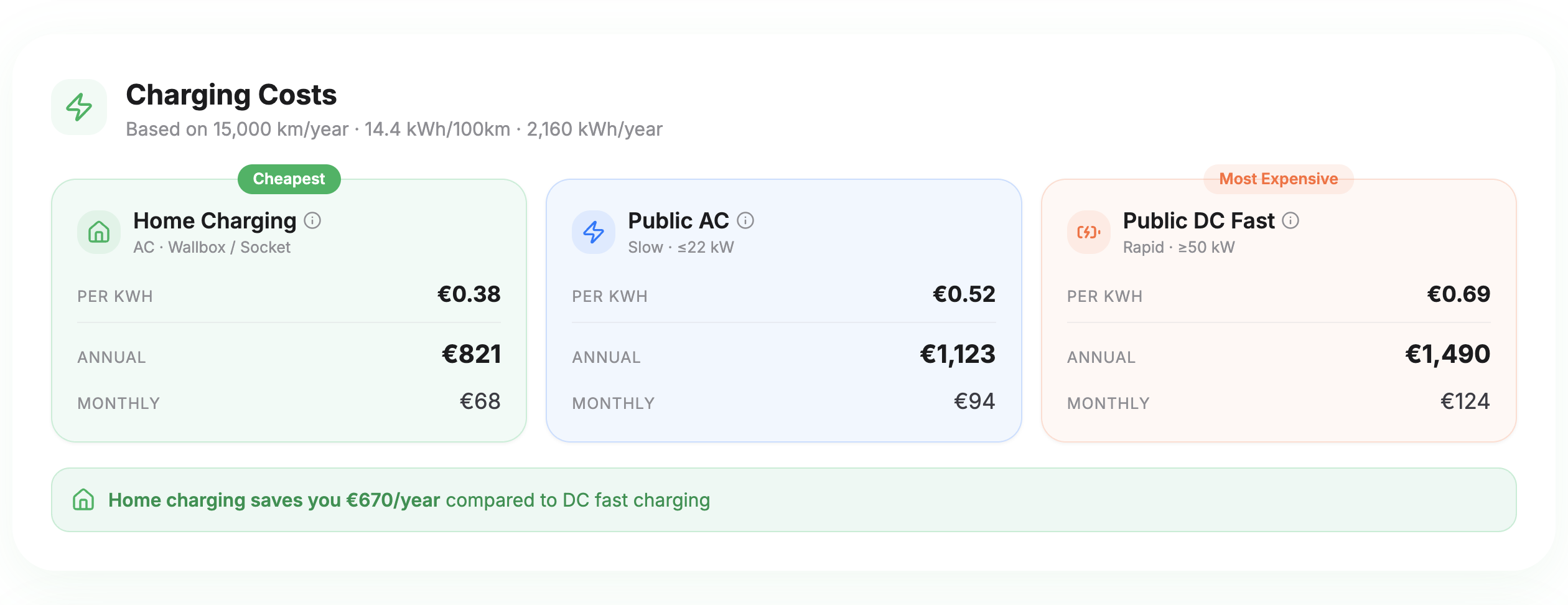
Ask any EV owner what their car costs to run and you'll get two very different answers depending on where they plug it in. The gap between charging at home and charging at a motorway rapid charger is the biggest variable in EV running costs, bigger than the model you pick and bigger than your annual mileage. In August 2026 it runs from roughly 2x in Germany to nearly 14x in Ukraine. Here's what it looks like in each of our five markets, and what it means for the way you actually drive.
If you want the country-by-country picture of what electricity costs across Europe, our EV charging cost comparison across Europe covers that. This post is the next question down: same country, same car, two very different plugs.
Table of Contents
- The gap at a glance
- United Kingdom: a tax split that's about to widen
- Germany: the narrowest gap in Europe
- France: heures creuses does the heavy lifting
- Spain: cheap at night, brutal on the motorway
- Ukraine: the widest gap of the five
- Why 20% of your kWh becomes most of your bill
- The second cost: what rapid charging does to the battery
- If you can't charge at home
- FAQ
- References
Quick summary
All figures below use 18.75 kWh per 100 km, the real-world average across 12,143 electric cars and 1,544,460 charge entries logged on Spritmonitor, retrieved 21 August 2026. That's 18.1% above the manufacturer catalogue figures for the same cars, which is roughly what you should expect in daily use.
| Market | Cheapest realistic home rate | Typical motorway rapid rate | Gap | Cost per 100 km, home vs motorway |
|---|---|---|---|---|
| UK | 8p/kWh (Intelligent Octopus Go) | 80p/kWh (Zapmap rapid average) | 10x | £1.50 vs £15.00 |
| Germany | 37.0 ct/kWh (BDEW household average) | 76 ct/kWh (IONITY direct) | 2.1x | €6.94 vs €14.25 |
| France | 15.89 ct/kWh (Tarif Bleu heures creuses) | 62 ct/kWh (IONITY direct) | 3.9x | €2.98 vs €11.63 |
| Spain | 8 ct/kWh (off-peak, indexed tariff) | 69 ct/kWh (IONITY direct) | 8.6x | €1.50 vs €12.94 |
| Ukraine | 2.16 UAH/kWh (night, two-zone meter) | 30 UAH/kWh (fast DC) | 13.9x | 40.5 UAH vs 562.5 UAH |
Two things jump out. The country with the cheapest home electricity does not have the smallest gap, it has one of the largest. And Germany is the outlier the other way: German households pay a lot for electricity, so the jump to a motorway charger is proportionally the smallest of the five, even though the absolute price per kWh is the highest here.
United Kingdom: a tax split that's about to widen
The Ofgem price cap for 1 July to 30 September 2026 sets the standard electricity unit rate at 26.11p/kWh with a 57.19p daily standing charge, for direct debit customers in England, Scotland and Wales. But almost nobody charging at home overnight pays that. Intelligent Octopus Go runs at 8p/kWh between 23:30 and 05:30, and Zapmap's index puts the typical off-peak home charging rate at about 8.6p/kWh.
Public charging is another world. Zapmap's July 2026 price index, published 4 August 2026, gives:
| Charger type | Pay-as-you-go price | Per mile |
|---|---|---|
| Standard and Standard Plus (3 to 49 kW) | 54p/kWh | 16p |
| Rapid and Ultra-Rapid (50 kW+) | 80p/kWh | 24p |
Some networks sit below that. Tesla Superchargers run at 63p/kWh for non-Tesla drivers and 46p/kWh for Tesla owners, and Sainsbury's Smart Charge is 72p/kWh. Many drivers pay less than the headline PAYG rate through memberships and promotions.
The UK gap is wide partly because of tax. Domestic electricity carries 5% VAT. Public charging carries 20%. And that split is about to get worse: the government announced on 21 July 2026 that VAT on domestic electricity drops from 5% to 0% from 1 October 2026, running to 31 March 2027, with an extension decision at the Autumn Budget. Northern Ireland is excluded under the Windsor Framework and gets equivalent support instead. Public charging is untouched by that cut and stays at 20%.
There is a live case that could change it. In Charge My Street v HMRC, the First-tier Tribunal accepted that electricity supplied at public charge points, under certain monthly consumption limits, can be treated as domestic use and taxed at 5%. HMRC is appealing to the Upper Tribunal, and the ruling does not take effect while the appeal is pending, with no hearing date set as of August 2026. Don't budget around it.
Germany: the narrowest gap in Europe
BDEW's price analysis, published 11 May 2026 on data from 15 April 2026, puts the average German household electricity price for 2026 at 37.0 ct/kWh for a 3,500 kWh a year household. That's down 2.3 ct from the 2025 average of 39.3 ct, but it's still the highest home rate among our five markets.
On the road, EnBW mobility+ has charged the same rate for AC and DC since December 2025:
| Tariff | Monthly fee | Price per kWh |
|---|---|---|
| S | none | 56 ct |
| M | €5.99 | 46 ct |
| L | €11.99 | 39 ct |
EnBW cut all tariffs by 5 ct/kWh for the summer, from 8 July to 30 September 2026, so tariff S sits at 51 ct until the end of September. IONITY raised its German prices from 1 July 2026 to 76 ct/kWh on direct payment, against 41 ct on a subscription.
One caveat: IONITY runs separate tariffs for app-registered users and walk-up payment, and German secondary sources quoted 68 to 72 ct for the registered app tariff in early July 2026. IONITY's own price pages block automated retrieval, so we could not read the primary figure directly. Check the price on the screen before you plug in, which under EU rules it now has to show you.
The German picture is unusual. On tariff L at 39 ct you're paying almost exactly what a German household pays at the wall socket, which makes an EnBW subscription competitive rather than a damage limitation exercise. That is not true anywhere else on this list.
France: heures creuses does the heavy lifting
EDF's Tarif Bleu changed on 1 August 2026. For a 6 kVA meter:
| Option | Price per kWh (incl. tax) | Annual subscription |
|---|---|---|
| Base | €0.2001 | €190.32 |
| Heures Pleines | €0.2142 | €190.32 |
| Heures Creuses | €0.1589 | €190.32 |
The off-peak rate rose only 0.63% at that revision while peak rose 3.73%, so the spread between them widened. If you charge overnight on the heures creuses option you're at €2.98 per 100 km.
Motorway charging is where it turns. IONITY France moved to €0.62/kWh direct from 1 July 2026, or €0.31 on a subscription. Across the broader French network, prices as of July 2026 run roughly €0.30 to €0.50/kWh on AC up to 22 kW, €0.50 to €0.65 on 50 to 150 kW DC, and €0.65 to €0.85 on ultra-rapid above 150 kW. Tesla sits at €0.45 to €0.55 for non-Tesla drivers, Electra around €0.44, TotalEnergies €0.45 to €0.60.
France has the cheapest IONITY direct price of the four EU markets we track: €0.62 here against €0.69 in Spain, €0.76 in Germany and €0.91 in Italy. If your summer route crosses a border, the charger you skip matters as much as the one you use.
Spain: cheap at night, brutal on the motorway
The PVPC regulated tariff averaged €0.1625/kWh in July 2026, up sharply from €0.1320 in June, according to OCU's tracking published 31 July 2026. That jump came from the wholesale market hitting €104.75/MWh, its highest since February 2025, and the typical household bill rose 16.8% to €77.84 for 292 kWh.
An EV owner on an indexed or time-of-use tariff charging in the small hours, though, can land between €0.04 and €0.10/kWh, or €2.50 to €4 per 100 km. Motorpasión's August 2026 breakdown puts Spanish public charging at €0.25 to €0.45/kWh on 22 to 50 kW, €0.30 to €0.55 on 50 to 150 kW, and €0.65 to €0.79 on ultra-rapid above 150 kW. IONITY Spain is €0.69 direct from 1 July 2026, €0.37 on subscription.
That combination, very cheap valley-hour electricity and ultra-rapid pricing in line with the rest of western Europe, produces the 8.6x gap. Spain rewards a driveway more than almost anywhere.
Ukraine: the widest gap of the five
The household electricity tariff is 4.32 UAH/kWh, set by Cabinet of Ministers Resolution No. 632 of 31 May 2024 and still in force. With a two-zone meter, the night rate between 23:00 and 07:00 is half that: 2.16 UAH/kWh. At 18.75 kWh per 100 km, overnight charging costs about 40.5 UAH per 100 km.
Public fast charging is a separate market and it repriced sharply this year. On 17 January 2026 the regulator NKREKP raised wholesale price caps to 15,000 UAH/MWh on the main market segments and 16,000 UAH/MWh on the balancing market. Charge point operators buy at commercial market rates, and within days fast charging moved from 18 to 20 UAH/kWh up to 30 to 32 UAH/kWh. Reported operator prices at the time: IONITY 29.99 UAH/kWh, VIWATT 31.99 UAH/kWh in Rivne oblast, ECOFACTOR 27 to 29 UAH/kWh in Lviv.
By May 2026 the spread had settled at roughly 18 to 24 UAH/kWh on AC up to 22 kW, 25 to 32 on 50 to 150 kW DC, and 28 to 35 on ultra-rapid. Kyiv is cheaper on AC, around 18 to 20 UAH/kWh, because more operators compete there. Highway stations charge a premium.
A driver with a night tariff at home and a habit of using highway DC pays almost fourteen times more per kilometre on the road than in the garage. No other market here comes close.
Why 20% of your kWh becomes most of your bill
Here is the calculation that actually matters, because almost nobody charges 100% at home or 100% in public. Take 15,000 km a year at 18.75 kWh per 100 km, which is 2,812.5 kWh, and split it 80% home and 20% rapid.
| Market | Home 80% | Rapid 20% | Annual total | Rapid's share of the bill |
|---|---|---|---|---|
| UK | £180 | £450 | £630 | 71% |
| Spain | €180 | €388 | €568 | 68% |
| France | €358 | €349 | €706 | 49% |
| Germany | €833 | €428 | €1,260 | 34% |
| Ukraine | 4,860 UAH | 16,875 UAH | 21,735 UAH | 78% |
A fifth of the energy, most of the money. In the UK and Ukraine that one-fifth accounts for more than 70% of the annual charging bill. This is why "what does an EV cost to run" has no single answer. The better question is "how often will I actually need to charge away from home?"
It also reframes the range question. A car with 100 km more usable range cuts the number of motorway stops per year, and each avoided stop is priced at 5 to 14 times your home rate. To see how much real range separates two specific cars, our comparison tool puts their real-world figures side by side, and WLTP vs real range explains why the official number isn't the one to plan around.
The second cost: what rapid charging does to the battery
Home charging is cheaper twice over, and the second saving never shows up on a bill.
Geotab's battery health study, released 13 January 2026 and covering more than 22,700 electric vehicles across 21 models, found an average degradation rate of 2.3% per year across the fleet. Split by charging behaviour, the picture separates:
| Charging pattern | Degradation per year | Projected capacity after 8 years |
|---|---|---|
| More than 40% of sessions above 100 kW | 3.0% | 76% |
| Mostly AC or lower-power DC | 1.5% | 88% |
That's a 12 percentage point difference in state of health after eight years, on the same cars. On a used EV, state of health is a direct input into what a buyer will pay, so the driver who lives on ultra-rapid chargers is paying twice: once at 80p or 76 ct per kWh, and again at resale.
Geotab also notes the fleet average has drifted back up to 2.3% from 1.8% in their 2023 analysis, which they attribute to wider use of high-power charging rather than to worse batteries. That matters if you're buying a three-year-old car with an unknown charging history: our used EV battery health guide covers how to check it.
If you can't charge at home
Around 32.8% of UK households, roughly 9 million, have no driveway, and about 20% of current EV drivers have no home charge point, per Zapmap's survey data from the end of 2025. The tables above show why that matters, but it doesn't make an EV a bad idea. It changes which options are worth chasing:
- Workplace and destination charging. Standard AC at 54p in the UK, or €0.25 to €0.45 in Spain, sits well below rapid pricing. Slow and boring beats fast and expensive.
- Subscriptions. IONITY Passport at €0.41 in Germany against 76 ct direct, or €0.31 against €0.62 in France, roughly halves the rate. On a monthly fee of €5.99 to €11.99, a single long trip a month can pay for it.
- Lamp post and on-street AC. Slower, usually cheaper than rapid, and it charges while you sleep whether or not you own the kerb.
- Buy the efficiency. If most of your kWh comes from public chargers, the difference between 15 and 22 kWh/100 km costs you on every single charge.
One thing EU rules now guarantee: since 13 April 2024, under AFIR, charge points above 50 kW must base the ad hoc price on price per kWh and display it at the station, on screen or on a sticker. Below 50 kW it has to be clearly available electronically. If you cannot see a per-kWh price at an EU fast charger, that's a compliance problem, not you missing it.
FAQ
Is it always cheaper to charge at home?
In every market we track, yes, on a per-kWh basis. What changes is by how much: about 2x in Germany, close to 14x in Ukraine on a night tariff. Germany is the only one of the five where a good public charging subscription gets you close to the household rate.
Does a special EV tariff make a big difference?
In the UK it's the single biggest lever available. Moving from the 26.11p capped standard rate to an 8p overnight EV tariff cuts home charging costs by about two thirds. In France the heures creuses option saves about 26% against heures pleines. In Spain, indexed tariffs with very low valley-hour prices produce the cheapest home charging of the five markets.
Will the UK VAT cut on electricity make public charging cheaper?
No. The cut from 5% to 0% that starts on 1 October 2026 applies to domestic electricity only. Public charging stays at 20% VAT. A tribunal ruled in Charge My Street v HMRC that some public charging could qualify for 5%, but HMRC is appealing and the decision is not in force.
How much does rapid charging really hurt the battery?
Geotab's data on 22,700+ cars puts it at 3.0% a year for vehicles where more than 40% of sessions exceed 100 kW, against 1.5% for cars charged mostly on AC or slower DC. That's a projected 76% versus 88% capacity after eight years. Occasional rapid charging on trips is not the issue. Making it your default is.
Which is cheaper on a long trip, IONITY or Tesla?
It depends on the country and on whether you subscribe. In France, Tesla at €0.45 to €0.55 for non-Tesla drivers undercuts IONITY's €0.62 direct rate, but IONITY Passport at €0.31 beats both. In the UK, Tesla at 63p for non-owners sits below the 80p rapid average. Check the app before you commit to a route.
Do these prices change often?
Yes, and not on a fixed calendar. The UK cap resets quarterly, French regulated tariffs change on 1 February and 1 August, Spanish PVPC moves daily with the wholesale market, and networks reprice whenever they like. Treat any figure older than a few months as a starting point, not a quote.
References
All figures verified 21 August 2026.
- Ofgem. Energy price cap unit rates and standing charges. https://www.ofgem.gov.uk/information-consumers/energy-advice-households/energy-price-cap-unit-rates-and-standing-charges
- Zapmap. UK EV charging price index: average cost per kWh (July 2026 data, published 4 August 2026). https://www.zapmap.com/ev-stats/charging-price-index
- Zapmap. Home and community EV charging statistics. https://www.zapmap.com/ev-stats/home-and-community-charging
- Octopus Energy. Intelligent Octopus Go. https://octopus.energy/smart/intelligent-octopus-go/
- vatcalc. UK cuts domestic energy VAT from 5% to 0% Oct 2026 (announced 21 July 2026). https://www.vatcalc.com/uk/uk-cuts-domestic-energy-vat-from-5-to-0-oct-2026/
- Fleet News. HMRC appealing court ruling on 5% public charging VAT rate for EVs. https://www.fleetnews.co.uk/news/hmrc-appealing-court-ruling-on-5-public-charging-vat-rate-for-evs
- BDEW. BDEW-Strompreisanalyse (published 11 May 2026, data 15 April 2026). https://www.bdew.de/service/daten-und-grafiken/bdew-strompreisanalyse/
- ecomento. EnBW senkt Ladepreise im Sommer um 5 Cent pro kWh (7 July 2026). https://ecomento.de/2026/07/07/enbw-senkt-ladepreise-im-sommer-um-5-cent-pro-kwh/
- Somos Eléctricos. IONITY sube precios de carga en Europa (23 June 2026, prices effective 1 July 2026). https://www.somoselectricos.com/noticias-puntos-carga/ionity-sube-precios-carga-europa-asi-afectara-bolsillo/20260623122511057465.html
- Kelwatt. Tarif Bleu EDF réglementé au 1er août 2026. https://www.kelwatt.fr/actu/tarif-edf-reglemente-1er-aout-2026
- Ohm Énergie. Prix recharge voiture électrique sur borne publique (updated 3 July 2026). https://ohm-energie.com/blog/prix-recharge-voiture-electrique-borne-publique
- OCU. Precio de la luz: evolución (July 2026 data, published 31 July 2026). https://www.ocu.org/vivienda-y-energia/gas-luz/informe/precio-luz
- Motorpasión. Cuánto cuesta cargar un coche eléctrico (18 August 2026). https://www.motorpasion.com/observatorio-motorpasion/cuanto-cuesta-cargar-coche-electrico
- Cabinet of Ministers of Ukraine. Resolution No. 632 of 31 May 2024, household electricity tariff, via Tariffa. https://tariffa.com.ua/tarif-na-elektroenergiy
- ZAXID.NET. Тарифи на зарядку електромобілів зросли (23 January 2026). https://zaxid.net/tarifi_na_zaryadku_elektromobiliv_zrosli_prichina_shho_bude_dali_poyasnennya_n1628676
- Electro-Auto. Зарядка електромобіля в Україні 2026 (28 May 2026). https://electro-auto.in.ua/zaryadka-elektromobilya-v-ukrayini-2026-cziny-i-realni-vytraty/
- Geotab. EV battery health: key findings from 22,700 vehicle data analysis (study released 13 January 2026). https://www.geotab.com/blog/ev-battery-health/
- Spritmonitor. Electricity consumption: all manufacturers, all models (retrieved 21 August 2026). https://www.spritmonitor.de/en/overview/0-All_manufactures/0-All_models.html?fueltype=5
- European Commission. Questions and answers on Regulation (EU) 2023/1804 (AFIR). https://transport.ec.europa.eu/transport-themes/clean-transport/alternative-fuels-sustainable-mobility-europe/alternative-fuels-infrastructure/questions-and-answers-regulation-deployment-alternative-fuels-infrastructure-eu-20231804_en